Financial Goals for Beginners: Short, Mid & Long-Term Goals Kaise Set Karein?
Random saving se nikal kar goal-based planning tak — ek practical, step-by-step Hinglish guide jo aapke financial goals ko clear aur achievable banayegi.

Financial Goals for Beginners: Is Article Mein Kya Kya Cover Hoga
- Financial Goal Kya Hai?
- Goal Setting vs Goal Planning
- SMART Financial Goals
- Short, Mid & Long-Term Goals
- Goals Ko Priority Kaise Dein?
- Needs vs Wants
- Financial Goal Set Karne Ke Steps
- Inflation Ka Impact
- Monthly Contribution Kaise Nikalein?
- Goal-Based Investing
- Three Goal Buckets
- Multiple Goals Ek Saath Manage Karna
- Low Income Mein Goals
- Common Mistakes
- Goal Review System
- 7-Day Action Plan
- Financial Goal Checklist
- FAQs
Financial goals for beginners ka topic aksar tab tak seriously nahi liya jaata jab tak confusion khud saamne na aa jaaye. Suppose aap har mahine ₹50,000 kama rahe hain, kuch SIP bhi chalu hai, phir bhi jab koi poochta hai “5 saal baad aapka financial plan kya hai?” — jawab clear nahi hota. Ghar kab le paayenge, bachhon ki education ke liye kitna chahiye, retirement corpus kitna hona chahiye — sab kuch dhundhla sa hai. Yahi wo gap hai jise financial goals for beginners ka concept fill karta hai.
Bina clear goal ke saving aur investing dono hi random ho jaate hain — kabhi zyada bachat, kabhi zero. Is article mein hum step-by-step samjhenge ki financial goals kaise set karein, unhe short, mid aur long-term mein kaise divide karein, aur ek realistic goal planning framework kaise banayein. Agar aap aur bhi beginner-friendly finance guides dhundh rahe hain, MoneyPicker.in par aapko free calculators aur educational articles ka poora collection milega.
🧭Financial Goals for Beginners: Financial Goal Kya Hai?
Financial goal ka matlab sirf “mujhe future mein paisa chahiye” nahi hota. Ek proper financial goal mein teen cheezein clear honi chahiye — amount, timeline, aur purpose. In teeno ke bina wo sirf ek wish hai, goal nahi.
Compare kariye:
- ❌ “Mujhe ghar kharidna hai.” — Ye ek wish hai.
- ✅ “Mujhe 7 saal mein ₹15 lakh ka home down payment corpus build karna hai.” — Ye ek financial goal hai.
Second statement mein amount, timeline aur purpose teeno define hain — isliye is goal ko actually plan kiya ja sakta hai. Yahi difference financial goal setting ko powerful banata hai.
🧠Goal Setting vs Goal Planning (Financial Goals for Beginners Ka Core Framework)
Goal Setting ka matlab hai decide karna ki kya achieve karna hai aur kab tak. Goal Planning ka matlab hai us goal ko achieve karne ke liye kitna save/invest karna hai aur kaise.
Ye seven-step framework is article ka core structure hai — har section isi flow ke around ghoomega.
✨SMART Financial Goals for Beginners
Beginners ke liye ek helpful mental model hai SMART framework:
- Specific — Goal clearly defined ho, generic nahi.
- Measurable — Ek target amount ho jise track kiya ja sake.
- Achievable — Aapki income aur time ke hisaab se realistic ho.
- Relevant — Aapki actual life priorities se match kare.
- Time-bound — Ek clear deadline ho.
Example: “Mujhe future ke liye save karna hai” ko SMART banayenge — “Mujhe 5 saal mein ₹6 lakh ka emergency-plus-travel fund banana hai, jisके लिए main ₹8,500 monthly contribute karunga.” Note: SMART goals success ki guarantee nahi dete, ye sirf clarity improve karte hain.
⏳Short-Term, Mid-Term Aur Long-Term Financial Goals for Beginners
Ye time ranges industry mein universal legal definitions nahi hain — different financial planners slightly different ranges use karte hain. Financial goals for beginners ke liye neeche ek practical, widely-used framework diya gaya hai jise easily follow kiya ja sakta hai.
🏃 Short-Term Goals
Approx. 0–3 saal
- Emergency fund
- Vacation
- Insurance premium
- Upcoming education fee
🚶 Mid-Term Goals
Approx. 3–7 saal
- Higher education
- Home down payment
- Business capital
- Vehicle purchase
🧗 Long-Term Goals
Approx. 7+ saal
- Retirement
- Children’s higher education
- Financial independence
- Long-term wealth creation
Short-term goals ke liye capital protection aur liquidity important hote hain, kyunki time kam hone ki wajah se market volatility recover hone ka waqt nahi milta. Mid-term goals mein approach thoda different ho sakta hai — ye aapke risk tolerance, goal certainty aur financial circumstances par depend karta hai; “5 saal ke liye hamesha X mein invest karo” jaisi simplistic advice avoid karni chahiye. Long-term goals jaise retirement mein compounding, inflation-adjusted planning aur disciplined periodic review important role play karte hain — lekin returns kabhi guaranteed nahi hote.
| Goal Type | Approx. Time Horizon | Examples | Main Planning Focus |
|---|---|---|---|
| Short Term | 0–3 years | Emergency fund, vacation, near-term expenses | Liquidity + capital protection |
| Mid Term | 3–7 years | Home down payment, education | Balance of growth + risk |
| Long Term | 7+ years | Retirement, long-term wealth | Growth + inflation management |
🚩Financial Goals for Beginners Ko Priority Kaise Dein?
Zyadatar logon ke paas ek saath multiple goals hote hain — emergency fund, insurance, car, home, vacation, child education, retirement. Financial goals for beginners ke liye sabko ek saath fund karna mushkil hota hai, isliye ek practical priority order helpful hota hai (ye rigid rule nahi hai — personal circumstances ke hisaab se badal sakta hai):
⚖️Needs vs Wants (Financial Goals for Beginners Ka Basic Filter)
Jab monthly income limited hoti hai, tab needs aur wants ko differentiate karna zaroori ho jaata hai. Needs wo goals hain jo aapki financial stability protect karte hain — jaise emergency fund aur essential insurance. Wants lifestyle goals hote hain jinhe adjust kiya ja sakta hai — jaise luxury vacation ya premium car. Ye distinction lifestyle spending ko shame karne ke liye nahi, balki priority-setting ko easy banane ke liye hai.
🪜Financial Goals for Beginners: Step-by-Step Kaise Set Karein
Ye article ka main practical framework hai jo har financial goal ke liye repeat kiya ja sakta hai:
- Goal Define Karein — Example: “Home down payment”
- Future Cost Estimate Karein — current cost, inflation, aur changing requirements consider karein
- Deadline Set Karein — Example: 7 saal
- Required Corpus Calculate Karein
- Monthly Contribution Determine Karein — ye starting amount, time horizon, assumed return aur contribution frequency par depend karta hai
- Suitable Saving/Investment Approach Choose Karein — koi single product sabke liye best nahi hota
- Periodically Review Karein — goals static nahi hote
📊Financial Goals Mein Inflation Ka Impact
₹10 lakh aaj jitna purchase kar sakte hain, utna kuch saal baad nahi kar payenge — kyunki cost of living badhti rehti hai. Agar hum sirf illustration ke liye 6% annual inflation assume karein, to formula hoga:
Future Cost = Current Cost × (1 + inflation rate) ^ number of years
📈 Illustrative growth of a ₹10L goal cost at an assumed 6% inflation — not a forecast.
Ye sirf illustration hai — actual inflation future mein isse kam ya zyada ho sakti hai. RBI ka current retail-inflation data RBI ki official website par available rehta hai, jise aap reference ke liye check kar sakte hain.
🧮Financial Goals for Beginners: Monthly Contribution Kaise Estimate Karein?
Ek baar future goal amount pata chal jaaye, to next step hai monthly contribution estimate karna: Future Goal Amount → Time Available → Expected/Assumed Return → Monthly Contribution.
Suppose kisi ko 8 saal mein ₹15,94,000 chahiye aur wo illustration ke liye 10% annual assumed return (guaranteed nahi) le kar chal raha hai, to approx. monthly SIP-style contribution ₹11,500–₹12,000 ke around aa sakta hai. Ye sirf ek hypothetical calculation hai — actual market returns vary kar sakte hain.

🎯Goal-Based Investing — Financial Goals for Beginners Ka Zaroori Concept
Bahut log sirf “Main bas SIP kar raha hoon” soch ke invest karte hain. Goal-based investing mein har investment ko ek specific goal se link kiya jaata hai — jaise emergency fund, home down payment, child education, ya retirement. Isse clarity, discipline, tracking aur decision-making sab improve hote hain — lekin ye returns better hone ki guarantee nahi deta.
Short horizon goals mein volatility ke liye tolerance kam hota hai, aur long horizon mein thodi zyada capacity hoti hai volatility absorb karne ki — lekin ye ek planning principle hai, guarantee nahi. “Long-term investment hamesha safe hai” jaisi soch galat hai; market risk hamesha exist karta hai.
🪣Goal Bucket System for Financial Goals for Beginners
Beginners ke liye apne financial goals ko organize karne ka ek simple tareeka hai three-bucket system:
🪣 Bucket 1
Immediate / Short-Term Goals
🪣🪣 Bucket 2
Medium-Term Goals
🪣🪣🪣 Bucket 3
Long-Term Goals
🤹Financial Goals for Beginners: Multiple Goals Ko Ek Saath Kaise Manage Karein?
Suppose kisi ka monthly investable surplus ₹15,000 hai aur unke goals hain — emergency fund, home, vacation, retirement. In sab ko fund karne ka tareeka hai: priority identify karein, har goal ke liye timeline assign karein, required contribution estimate karein, aur overcommit na karein. Zaroori nahi ki har goal ko ek saath aggressively fund kiya jaaye — lower-priority goals ko temporarily adjust bhi kiya ja sakta hai.
Agar aapka goal ₹1 crore jaisa bada long-term wealth target hai, to MoneyPicker ka ₹1 Crore Calculator aapko approximate timeline aur contribution samajhne mein help kar sakta hai.
🌱Low Income Mein Financial Goals Kaise Set Karein?
Agar income limited hai, to protection aur basic stability se shuru karein — ek ya do important goals prioritize karein, unrealistic monthly targets avoid karein, aur income badhne ke saath contributions increase karte jaayein. Salary increment ya bonus aane par contribution step-up karna helpful hota hai — is concept ko step-up contribution kehte hain, jise MoneyPicker ka Step-Up SIP Calculator visualize karne mein madad karta hai.
Yaad rakhein — consistency, unrealistic targets se better hai. Chhoti saving bhi guilt ki baat nahi hai.
❌Common Mistakes Financial Goals for Beginners Karte Hain
- Vague goals — Solution: amount + timeline + purpose add karein.
- No deadline — Solution: har goal ko ek target year dein.
- Inflation ignore karna — Solution: future cost estimate mein inflation include karein.
- Unrealistic targets — Solution: income ke hisaab se realistic contribution set karein.
- Ek saath bahut saare goals fund karna — Solution: priority-based approach use karein.
- Sirf short-term par focus — Solution: long-term goals bhi timeline mein shamil karein.
- Retirement ignore karna — Solution: retirement ko ek early priority banayein.
- Near-term goal ke liye excessive risk — Solution: time horizon ke hisaab se risk match karein.
- Kabhi review na karna — Solution: quarterly/annual review schedule banayein.
- Bina purpose ke invest karna — Solution: har investment ko ek goal se link karein.
- Doosron ka plan copy karna — Solution: apni income aur circumstances ke hisaab se plan banayein.
- Returns ko guaranteed samajhna — Solution: assumptions ko hamesha illustrative maanein.
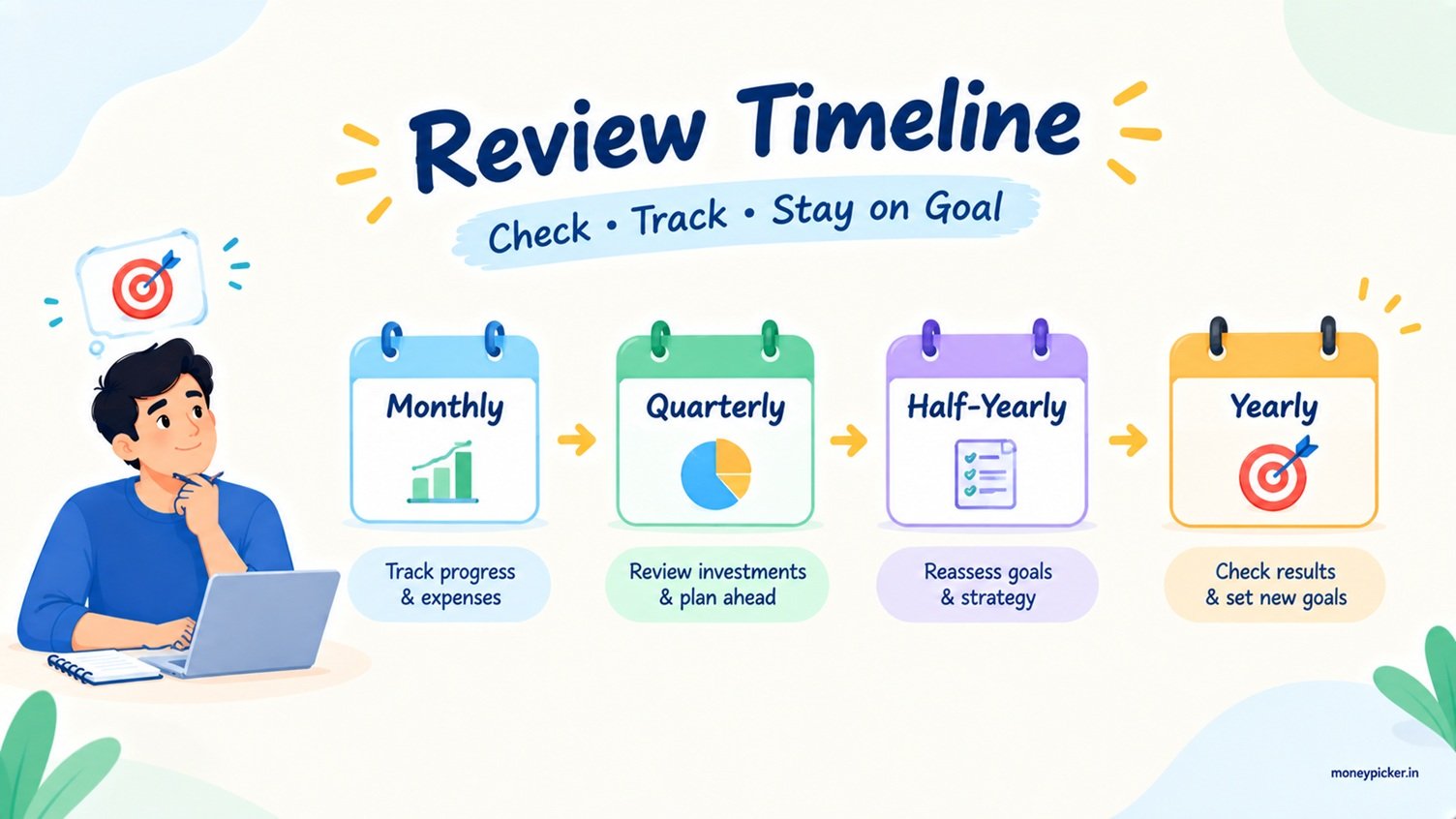
🔁Financial Goals for Beginners: Goal Review System
Financial goals “ek baar set karo aur bhool jao” wali cheez nahi hain.
📅 Monthly
Contribution track karein, expenses check karein
🗓️ Quarterly
Savings progress, short-term goals review
📆 Annually
Goal amount, inflation assumption, timeline, income, priorities revisit
Financial Goal Scorecard (Example)
| Goal: Home Down Payment | Status |
|---|---|
| Clarity | On Track |
| Timeline | On Track |
| Target Amount | On Track |
| Current Savings | Needs Attention |
| Monthly Contribution | Off Track |
Ye scorecard help karta hai identify karne mein ki financial goals for beginners ki planning ke kis part mein sabse zyada attention chahiye.
Goal-Based Planning vs Random Saving
| Random Saving | Goal-Based Planning |
|---|---|
| “Paisa bacha raha hoon” | “₹X goal ke liye save kar raha hoon” |
| No deadline | Defined timeline |
| No target amount | Target corpus |
| Hard to track | Easy to track |
| Motivation fluctuate karti hai | Purpose discipline create karta hai |
Financial Goal Planning Worksheet — Financial Goals for Beginners Ke Liye Reference Template
| Goal | Current Cost | Target Year | Future Cost | Already Saved | Monthly Contribution | Priority |
|---|---|---|---|---|---|---|
| Emergency Fund | — | — | — | — | — | High |
| Home | — | — | — | — | — | Medium |
| Education | — | — | — | — | — | High |
| Retirement | — | — | — | — | — | High |
Agar aapka koi goal retirement se juda hai, to MoneyPicker ka Retirement Corpus Calculator future corpus estimate karne mein useful ho sakta hai, aur home-loan related goals ke liye EMI Calculator dekh sakte hain.
🌍Financial Goals for Beginners: Examples for Different Life Stages
Har koi ek hi sequence follow nahi karta, lekin broadly kuch common patterns dikhte hain:
- Student/Young Adult: emergency savings, skill development, first investment, travel
- Early Career: emergency fund, insurance, debt management, home down payment, retirement
- Family Stage: children’s education, home, retirement, family protection
- Pre-Retirement: retirement corpus, debt reduction, healthcare planning, income stability
📅Financial Goals for Beginners: 7-Day Action Plan

✅Financial Goals for Beginners: Final Checklist
- Mera goal clearly defined hai
- Goal amount estimate kiya hai
- Target date set hai
- Inflation ko consider kiya hai
- Goal priority decide ki hai
- Monthly contribution estimate kiya hai
- Time horizon ke according risk consider kiya hai
- Progress track karne ka system hai
- Goals ko periodically review karunga
- Return assumptions ko guarantee nahi samjha hai
Aap SEBI ke investor education resources bhi explore kar sakte hain financial planning basics ko aur deepen karne ke liye (ye financial goals for beginners ke liye ek accha starting point hai): SEBI Investor Education Website, aur mutual fund related basics ke liye AMFI Investor Corner.
❓FAQs — Financial Goals for Beginners
Financial goal kya hota hai?
Financial goal ek aisa target hai jisme amount, timeline aur purpose clearly defined ho — sirf ek generic wish nahi.
Financial goals kaise set karein?
Goal define karke, future cost estimate karke, deadline set karke, corpus calculate karke aur monthly contribution decide karke financial goals set kiye ja sakte hain.
Short-term financial goals kya hote hain?
Ye generally 0–3 saal ke andar achieve hone wale goals hote hain, jaise emergency fund ya vacation.
Mid-term financial goals kya hote hain?
Ye generally 3–7 saal ke goals hote hain, jaise home down payment ya higher education.
Long-term financial goals kya hote hain?
Ye generally 7+ saal ke goals hote hain, jaise retirement ya financial independence.
Short, mid aur long-term goals mein kya difference hai?
Inka main difference time horizon aur risk approach mein hota hai — short-term mein liquidity priority hoti hai, long-term mein growth aur inflation management.
Financial goal planning kya hoti hai?
Goal planning ka matlab hai us goal ko achieve karne ke liye kitna save/invest karna hai aur kaise, ye decide karna.
Goal-based investing kya hai?
Har investment ko ek specific financial goal se link karna, taaki clarity aur discipline improve ho.
Financial goals mein inflation ko kyun consider karna chahiye?
Kyunki aaj ka amount future mein utni purchasing power nahi rakhega — inflation ignore karne se goal underestimate ho sakta hai.
Ek saath multiple financial goals ko kaise manage karein?
Priority set karke, timeline assign karke aur available surplus ko goals ke beech systematically allocate karke.
Low income mein financial goals kaise set karein?
Protection se shuru karein, ek-do priority goals choose karein, aur income badhne ke saath contribution step-up karein.
Financial goals ko kitni baar review karna chahiye?
Ideally monthly quick check, quarterly progress review aur annually full review recommended hai.