SWP for Beginners: Systematic Withdrawal Plan Kya Hai, Retirement & SWP vs FD Explained
Units redeem hoti hain, interest nahi milta. Simple examples, risks aur SWP vs FD.
- 10 min read
- Beginner friendly
SWP for beginners samajhna ho to ek scenario se shuru karte hain. Suppose Rakesh ne kaam ke saalon mein retirement corpus banaya. Ab salary band hai, lekin ghar ka kharcha, dawai aur bills chalte hain. Sawal: corpus se regular kharcha kaise nikale, bina ek saath bada amount withdraw kiye?
Yahin Systematic Withdrawal Plan (SWP) ka naam aata hai. Is SWP for beginners guide mein SWP kya hai, kaise kaam karta hai, retirement role, SWP vs FD aur risks samjhenge. SWP guaranteed monthly income nahi deta. Ye MoneyPicker ka educational guide hai, personalized advice nahi.

SWP for Beginners: SWP Kya Hai?
SWP ka full form Systematic Withdrawal Plan hai. Ye mutual fund investment se monthly ya quarterly jaise periodic intervals par planned amount nikalne ki facility ya strategy hai. Options scheme aur platform ke setup par depend karte hain.
Har withdrawal ke liye kuch units redeem (sell) hoti hain aur paisa bank account mein aata hai. Baaki units invested rehti hain. Aap fixed rupee amount set kar sakte ho, ya percentage-based planning soch sakte ho.
SWP for Beginners: SWP Kaise Kaam Karta Hai?
SWP for beginners ke liye ye illustration kaafi hai: paisa “interest” ki tarah nahi aata, units redeem hoti hain.
Actual redemption amount, number of units aur portfolio value applicable NAV aur investment performance par depend karegi.
SWP Ke 6 Steps
- Mutual fund mein investment hota hai.
- Investor SWP amount aur frequency choose karta hai (scheme/platform ke hisaab se).
- Withdrawal date par applicable NAV par required units redeem hoti hain.
- Redemption proceeds investor ko milte hain.
- Baaki units invested rehti hain.
- Aage ka withdrawal corpus, market performance aur amount par depend karta hai.

SWP Example: ₹20 Lakh Corpus aur ₹15,000 Monthly
Maan lo corpus ₹20,00,000 aur monthly withdrawal ₹15,000 hai. Annual withdrawal = ₹15,000 × 12 = ₹1,80,000 (illustrative).
Lekin corpus har saal sirf ₹1.80 lakh kam nahi hoga, kyunki bacha investment gain ya loss dono kar sakta hai. SWP active ho to market movement ke bawajood withdrawals chalte rehte hain. Sustainability returns, withdrawal amount, taxes, inflation, fees aur time period par depend karti hai. Ye example guaranteed nahi hai.
NAV aur Units: Withdrawal ka Simple Math
Suppose investment value ₹10,00,000 aur NAV ₹100 hai, yaani approx 10,000 units. ₹10,000 withdrawal par 100 units redeem hongi. NAV badle to same ₹10,000 ke liye units badal jaati hain.
Illustrative; exact mechanics scheme rules par depend karte hain.
SWP vs Interest: Sabse Bada Confusion
SWP withdrawal ≠ interest income
SWP mein generally mutual fund units sell hoti hain. FD interest, FD ki terms ke hisaab se interest income hota hai.
Withdrawal ≠ return
SWP se ₹20,000 nikle, iska matlab ye nahi ki investment ne ₹20,000 kamaye. Us period mein portfolio badh sakta hai, gir sakta hai ya stable reh sakta hai.
Retirement Ke Liye SWP Kaise Use Ho Sakta Hai?
Retirement mein salary band hoti hai, kharche chalte hain. Isliye kuch retirees SWP for retirement jaisa systematic withdrawal approach consider karte hain:
- Working years
- Corpus building
- Retirement
- SWP / withdrawal strategy
- Regular cash flow
- Periodic review
Retirees isliye dekhte hain: regular cash-flow, bada ek-baar redemption avoid karna, customizable amount aur invested rehta corpus. Planning ke liye MoneyPicker ke free tools aur calculators dekh sakte ho. Lekin SWP ye guarantee nahi karta ki corpus poori retirement chalega.

Retirement SWP Example: ₹30 Lakh Corpus
Hypothetical example: corpus ₹30 lakh, planned monthly withdrawal ₹20,000, yaani annual ₹2.4 lakh. Ye illustrative example hai, universal safe recommendation nahi.
Retirement Ke Alag Stages
Retirement Se Pehle
Corpus building, diversification, emergency savings, insurance.
Retirement Ke Time
Expense estimate, income sources, withdrawal plan, liquidity.
Retirement Ke Dauran
Review, inflation, market performance, badalte kharche.
SWP ek component ho sakta hai, baaki sources ka replacement nahi. Healthcare, lambi life expectancy aur unexpected kharche bhi aate hain, isliye plan flexible hona chahiye.
- Pension
- EPF/PF savings
- Annuity
- Bank deposits
- Mutual funds
- Rental income
- Other investments
SWP Withdrawal Rate aur SWP Calculation Kaise Karein?
SWP for beginners ke liye SWP calculation ke do basic steps hain:
₹20,000 × 12 = ₹2,40,000
₹2,40,000 ÷ ₹30,00,000 × 100
Ye 8% sirf illustrative hai, safe ya unsafe label nahi. Higher withdrawal rate corpus par zyada pressure daal sakta hai, khaaskar jab returns weak ho ya inflation high. Returns, asset allocation, volatility, taxes, fees, retirement duration, sequence risk aur other income bhi matter karte hain, isliye koi magic percentage nahi.
Overall position ke liye MoneyPicker ka Financial Health Score Calculator use kar sakte ho. Calculator output guaranteed nahi hota.
SWP + Inflation: Kharcha Time Ke Saath Badhta Hai
Aaj ka ₹40,000 monthly kharcha 10 ya 20 saal baad same purchasing power nahi dega. 6% hypothetical inflation (illustrative assumption; actual inflation alag ho sakti hai) maanein to:
Isliye fixed withdrawal amount ko time ke saath review karna padta hai. Inflation data ke liye RBI ki official website dekh sakte ho.
SWP + Market Risk aur Sequence of Returns Risk
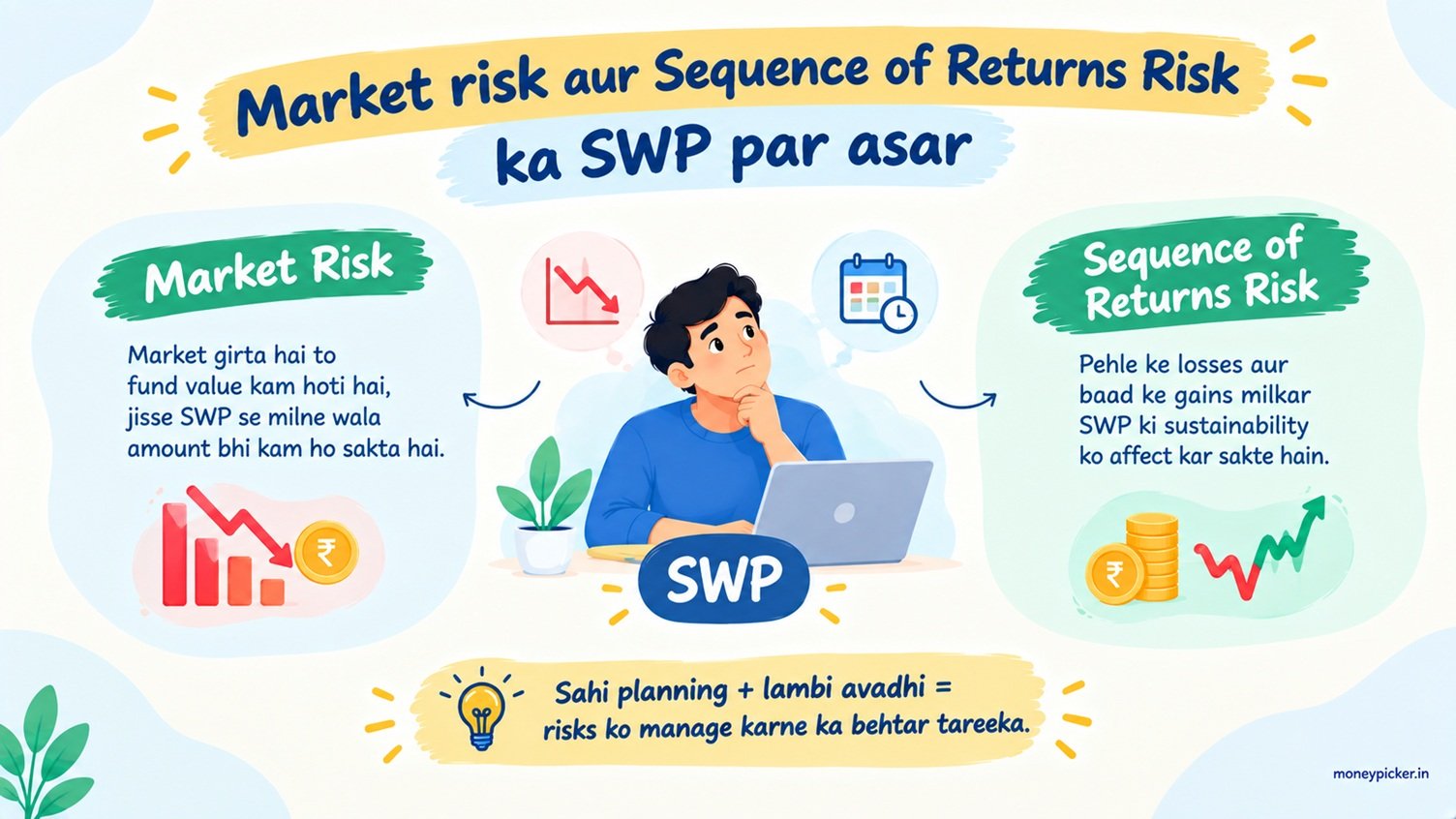
SWP market risk remove nahi karta. Fund gire aur withdrawal chalta rahe, to same rupee amount ke liye zyada units redeem karni pad sakti hain; actual outcome market conditions par depend karta hai.
- Market Down
- NAV Lower
- More Units Needed for Same Withdrawal
- Potentially Faster Unit Reduction
Sequence of Returns Risk Kya Hai?
Do investors ka average return same ho sakta hai, lekin returns ka order alag. Shuruaati kharab saal zyada bhaari pad sakte hain, kyunki withdrawal girte portfolio mein bhi chalta hai.
| Saal | Investor A: return → value | Investor B: return → value |
|---|---|---|
| Year 1 | +20% → ₹11,20,000 | -20% → ₹7,20,000 |
| Year 2 | 0% → ₹10,40,000 | 0% → ₹6,40,000 |
| Year 3 | -20% → ₹7,52,000 | +20% → ₹6,88,000 |
Average return dono ka 0% aur total withdrawal ₹2,40,000 hai, phir bhi ending value alag hai (bina withdrawal ke dono ₹9,60,000). Taxes/costs ignore kiye gaye hain.
SWP Benefits: Beginners Ko Kya Fayda Ho Sakta Hai?
Regular Cash Flow
Recurring expenses meet karne mein help kar sakta hai.
Flexible Amount
Amount/frequency rules ke andar choose ho sakti hai.
Corpus Invested Rehta Hai
Poora corpus ek saath nikalna zaroori nahi.
Retirement Income Planning
Broader strategy ka ek component ho sakta hai.
Customizable
Kharche badlein to amount review ho sakta hai.
Bada Ek-Baar Redemption Avoid
Corpus tak structured access milta hai.
SWP for Beginners: 7 Essential Risks aur Limitations
1. Market Risk
Fund ki value badh ya gir sakti hai.
2. Corpus Depletion
Withdrawal growth se zyada ho to corpus ghat sakta hai.
3. Inflation Risk
Fixed withdrawal ki purchasing power ghat sakti hai.
4. Sequence Risk
Shuruaati kharab returns extra pressure banate hain.
5. Tax Impact
Capital gains tax fund category, holding period aur rules par depend karta hai. Current rules Income Tax Department se verify karein.
6. Fees / Costs
Scheme expenses aur transaction costs asar daalte hain.
7. No Guaranteed Income
SWP guaranteed pension nahi hai.
SWP vs FD: Main Difference Kya Hai?
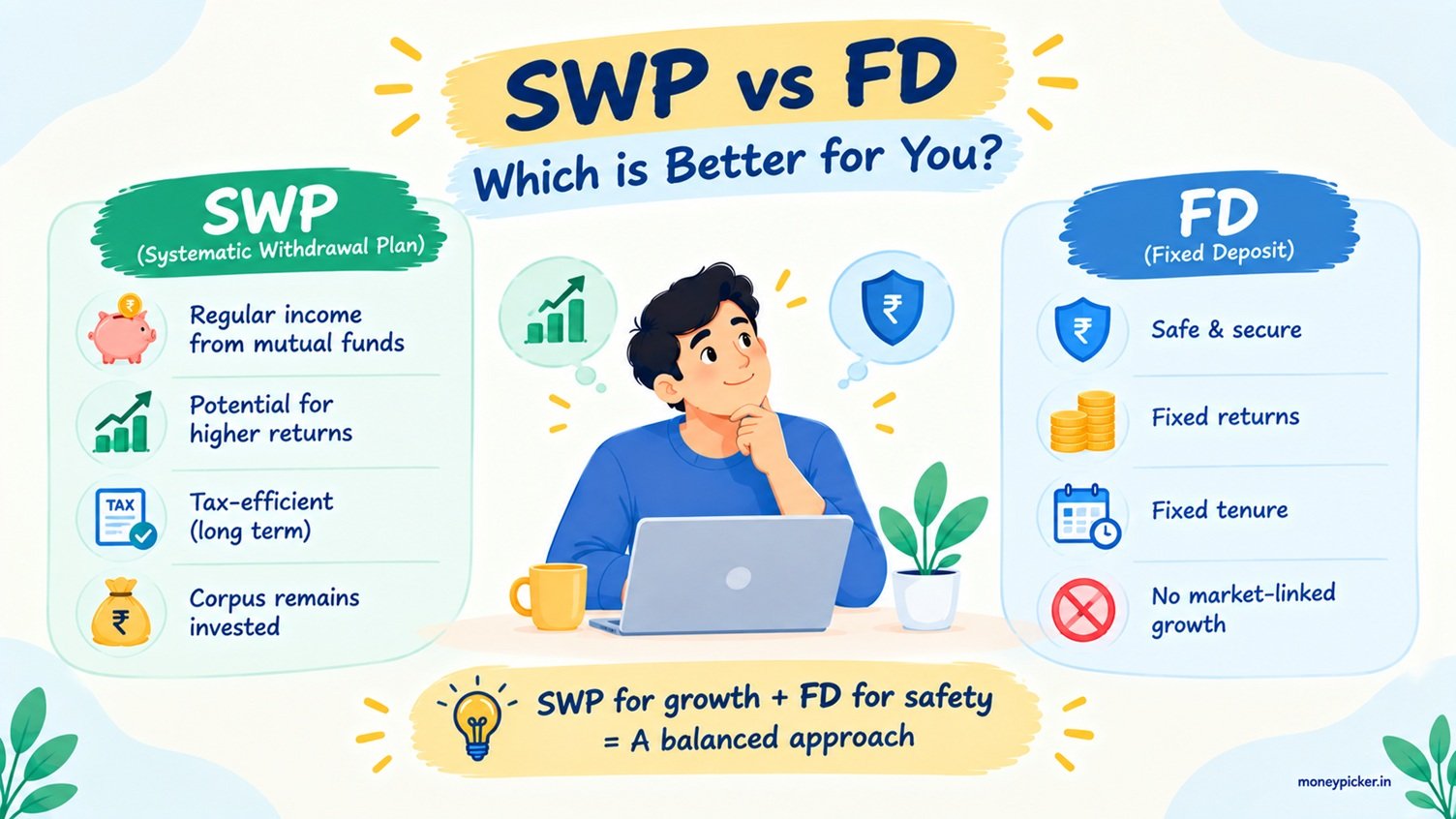
SWP for beginners ke liye SWP vs FD ka matlab winner dhundhna nahi, structure ka farq samajhna hai.
| Feature | SWP | FD |
|---|---|---|
| Structure | Mutual fund withdrawal strategy | Fixed deposit |
| Return nature | Market-linked | Interest rate FD terms se tay |
| Capital value | Fluctuate kar sakti hai | Generally deposit terms ke hisaab se fixed |
| Withdrawal | Periodic redemption of units | Interest payout ya premature withdrawal |
| Market risk | Haan | Market-linked NAV risk nahi |
| Liquidity | Scheme/transaction rules par depend | FD terms aur premature withdrawal rules par depend |
| Tax treatment | Capital gains aur applicable rules par depend | Interest generally taxable, as applicable |
| Inflation risk | Returns aur withdrawal strategy par depend | Fixed interest par inflation risk ho sakta hai |
| Suitable use | Potential retirement withdrawal strategy | Fixed-income / deposit-oriented planning |
SWP vs FD Example: ₹20 Lakh
Maan lo ₹20 lakh: SWP mein ₹15,000/month withdrawal, ya FD mein deposit. Comparison sirf “SWP return X, FD return Y” nahi hai. SWP mein units redeem hoti hain aur corpus value fluctuate kar sakti hai; FD interest contracted terms par depend karta hai. Tax treatment alag hai. FD rates badalte rehte hain, isliye yahan koi rate nahi liya; current rates bank ya RBI ke updates se check karein.
Decision Framework: Priority Ke Hisaab Se
| Agar aapki priority hai… | Consider karne wali cheezein |
|---|---|
| Predictable contractual interest | FD structure |
| Market-linked growth potential | Mutual fund structure |
| Corpus se regular withdrawal | SWP |
| Capital stability | FD terms aur deposit conditions |
| Inflation-beating potential | Actual returns, inflation, time horizon par depend |
| Retirement income | Dono ko context mein evaluate karein |
SWP
- Mutual fund-linked
- Market risk
- Unit redemption
- Flexible withdrawal structure
- Potential growth
- Variable portfolio value
FD
- Deposit product
- Contracted interest terms
- No NAV fluctuation
- Premature withdrawal rules ho sakte hain
- Interest income
- Alag taxation
SWP Guaranteed Pension Nahi Hai: Corpus Sustainability
- Withdrawal amount instruction se tay ho sakta hai.
- Portfolio value fixed nahi hoti.
- Mutual fund returns guaranteed nahi hain.
- Corpus ghat sakta hai.
SWP for beginners ki badi galatfehmi pension wali soch hai. Simplified framework (poora accounting formula nahi):
High withdrawals, low returns, high inflation aur lambi retirement corpus par pressure bana sakte hain.
₹30 Lakh Corpus Journey
- ₹30 lakh corpus
- Investment deployed
- Monthly withdrawal
- Remaining corpus
- Market movement
- Periodic review
SWP for Beginners: 12 Common Mistakes aur Myths vs Facts
- SWP ko guaranteed income maanna
- Kharche check kiye bina amount chunna
- Inflation ignore karna
- Market volatility ignore karna
- Bahut high withdrawal rate rakhna
- Maan lena ki past returns repeat honge
- Taxes ignore karna
- Sequence of returns risk ignore karna
- SWP ko FD interest ke barabar samajhna
- Withdrawal plan kabhi review na karna
- Ek hi investment par poora plan rakhna
- Withdrawal amount ko investment return samajhna
Myths vs Facts
SWP Decision Checklist aur Worksheet
SWP for beginners checklist (educational, personalized advice nahi):
- Retirement corpus kitna hai?
- Monthly expenses kitne hain?
- Other income sources kya hain?
- Inflation ko account kiya hai?
- Withdrawal amount realistic hai?
- Market volatility handle kar sakte hain?
- Taxes/costs considered hain?
- Lambi retirement duration considered hai?
- Regular review ka plan hai?
SWP kab consider ho sakta hai
Corpus ho, periodic cash flow chahiye, market risk samajh aaye aur withdrawal planned ho.
SWP kab reconsider karein
Corpus chhota ho, withdrawal bahut high ho, horizon lamba ho, portfolio volatile ho ya emergency liquidity na ho.
SWP Ko Kitni Baar Review Karein?
Koi rigid universal frequency nahi hoti. Periodic review mein ye dekhein:
- Portfolio performance
- Withdrawal needs
- Inflation
- Market conditions
- Expenses
- Other income
- Remaining corpus
- Major life changes
| Input | Your Number |
|---|---|
| Retirement Corpus | |
| Monthly Expense | |
| Monthly SWP | |
| Annual Withdrawal | |
| Initial Withdrawal Rate | |
| Expected Retirement Duration | |
| Other Income | |
| Inflation Assumption | |
| Review Frequency |

SWP for Beginners: Simple Language Mein Samjhein
- Mutual fund investment se periodic withdrawal
- Units redeem hoti hain
- Regular cash flow plan kiya ja sakta hai
- Remaining corpus invested reh sakta hai
- Market risk remains
- Corpus depletion possible hai
- Retirement planning ka ek component ho sakta hai
- Guaranteed pension nahi hai
SWP for Beginners FAQs: Aksar Poochhe Jaane Wale Sawal
SWP kya hota hai?
SWP yaani Systematic Withdrawal Plan mutual fund se periodic withdrawal ki facility hai; units redeem hoti hain.
SWP aur SIP mein kya difference hai?
SIP mein regular paisa invest hota hai; SWP mein regular paisa nikalta hai.
Kya SWP mein har month interest milta hai?
Nahi. SWP generally units redeem karke paisa deta hai; ye interest income nahi hai.
Retirement ke liye SWP kaise use kiya ja sakta hai?
Retirees expenses aur risk dekhkar planned withdrawal set karte hain aur use review karte hain. Ye plan ka ek component ho sakta hai.
SWP vs FD mein kya difference hai?
SWP market-linked unit redemption hai; FD deposit hai jismein interest terms se tay hota hai. Risk, liquidity aur tax alag hain; koi winner nahi.
Kya SWP guaranteed monthly income deta hai?
Nahi. Withdrawal amount tay ho sakta hai, lekin portfolio value aur returns nahi.
SWP mein corpus khatam ho sakta hai?
Haan. Withdrawals returns se zyada hon ya market weak rahe, to corpus kaafi kam ho sakta hai ya khatam bhi ho sakta hai.
SWP withdrawal rate kya hota hai?
Annual withdrawal ÷ starting corpus × 100. Jaise ₹2.4 lakh ÷ ₹30 lakh = 8%. Ye safe rate nahi, sirf concept hai.
SWP par tax kaise apply hota hai?
Tax capital gains rules, fund category aur holding period par depend karta hai. Current rules Income Tax Department se verify karein.
SWP start karne se pehle kin factors ko consider karna chahiye?
Corpus, expenses, other income, inflation, tax, volatility, retirement duration aur review plan.
Aur Padhein
Financial Health Score Check Karein
Disclaimer: This article is for educational purposes only and does not constitute personalized financial or investment advice. Mutual fund investments are subject to market risks, and returns are not guaranteed. SWP examples and calculations use hypothetical assumptions. Tax rules and product terms may change, so verify applicable details before making financial decisions. Details: MoneyPicker disclaimer.