[DISCLAIMER BANNER] This article is for educational purposes only and should not be considered personalized financial or investment advice. Intraday trading involves substantial risk of loss, including the possibility of losing more than your initial investment.
Table of Contents
Introduction
Aapne kabhi dekha hoga na market 9:15 AM par open hota hai, aur stocks-indices pehle 30 minutes mein 1–2% upar ya neeche chale jaate hain. Yahin se beginners ke mind mein ekdum se question aata hai:
“Agar stocks itni fast move kar rahi hain, toh daily paisa kaise nahi kama sakte?”
Yeh soch bilkul natural hai. Lekin reality kuch alag hi hai.
Intraday trading possible hai, profit bhi iska possible hai — lekin sirf entry pe focus karne se nahi. Jo beginner sabse badi galti karte hain wo hai:
“Ek acha entry dekha → trade lia → uske baad planning shuru kiya.”
Ye tarika loss ka guarantee hota hai.
Aaj ka ye article sikhayega ki intraday trading actually kaise kaam karta hai, paise kaise manage karte hain, kab trade karni chahiye, aur sabse important — kab nahi karni chahiye.
Ready? Chaliye shuru karte hain.
What is Intraday Trading?
Intraday trading ka matlab ek hi trading session (ek din) mein buy karke sell karna, ya short sell karke buy-back karna. Position same day ke andar close hona zaroori hai — overnight hold nahi rehta.
Intraday Trading in Simple Words
Intraday trading sirf ek tarika nahi hota — do tarike hote hain:
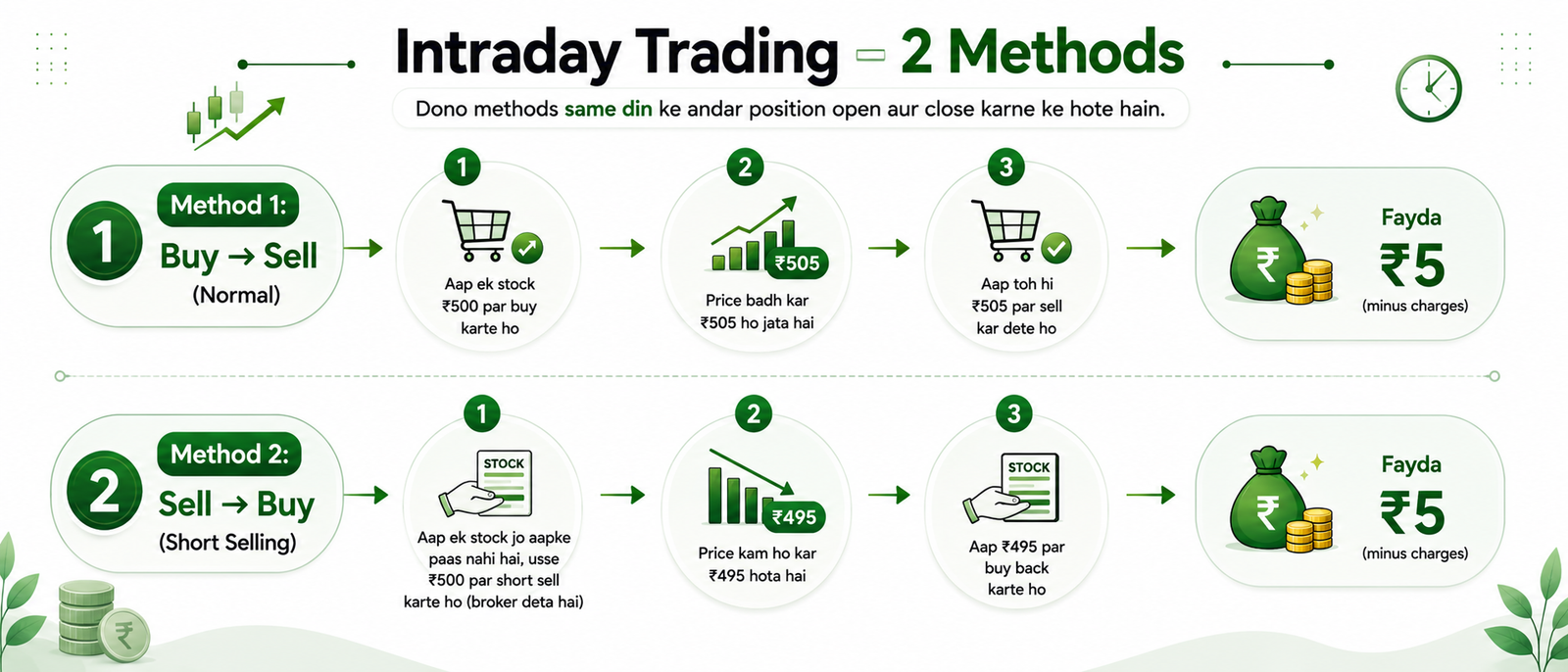
Method 1: Buy → Sell (Normal)
- Aap ek stock ₹500 par buy karte ho
- Price badh kar ₹505 ho jata hai
- Aap toh hi ₹505 par sell kar dete ho
- Fayda = ₹5 (minus charges)
Method 2: Sell → Buy (Short Selling)
- Aap ek stock jo aapke paas nahi hai, usse ₹500 par short sell karte ho (broker deta hai)
- Price kam ho kar ₹495 hota hai
- Aap ₹495 par buy back karte ho
- Fayda = ₹5 (minus charges)
Important: Short selling kaafi risky hoti hai kyunki price theoretically unlimited upar ja sakti hai. Entry par loss unlimited ho sakta hai — isliye risk management supar zaroori hota hai.
Intraday vs Long-Term Investing
| Factor | Intraday Trading | Long-Term Investing |
|---|---|---|
| Holding Period | Few minutes to same day | Months to years |
| Objective | Capitalize on price swings | Build wealth over time |
| Risk Level | Very High | Moderate to High |
| Time Required | 3-6+ hours daily during market | Minimal daily attention |
| Market Monitoring | Constant chart watching | Occasional portfolio review |
| Emotional Pressure | Extreme — live P&L fluctuation | Lower — focuses on fundamentals |
| Beginner Difficulty | Very High | Low to Moderate |
Real talk: Zyada beginners intraday mein loss karte hain kyunki daily monitoring aur discipline kaafi difficult hota hai.
How Intraday Trading Works: 10-Step Process
Ek complete trade cycle kya hota hai, samjhte hain:
- Liquid stock/index select karo — high volume wali, jisme entry-exit easy ho
- Price action analyze karo — chart dekho, trend samjho
- Setup identify karo — kya entry signal ban raha hai
- Entry price decide karo — exactly kis price par entry lena
- Stop-loss define karo — agar galat nikle to kitna nuksaan uthaounge
- Position size calculate karo — kitne shares/quantity
- Trade enter karo — actual order place karo
- Position manage karo — continuously monitor, adjust nahi karte unless needed
- Exit execute karo — target pa ya stop-loss par
- Journal mein record karo — kya hua, kyu hua, kya seekha
Sabse important point: Entry sirf 10% part hai — 90% risk management, position sizing, aur discipline ka hota hai.
How Much Money Do You Need? Reality Check
Kai brokers ₹5,000-₹10,000 se start karne dete hain, lekin capital kum, losses bhi potential kum, aur profits bhi kum.
Scenario 1: ₹5,000 Capital
- Maximum daily loss target: ₹50 (1%)
- Kuch hi rupees ka swing significant loss ban jata hai
- Unrealistic expectations ka risk
- Verdict: Seekhne ke liye kaafi kam
Scenario 2: ₹10,000 Capital
- Maximum daily loss: ₹100 (1%)
- Position size bahut chota hota hai
- Logistics overhead (brokerage, taxes) significant % consume karti hain
- Verdict: Seekhne ke liye theek hai
Scenario 3: ₹25,000 Capital
- Maximum daily loss: ₹250 (1%)
- Position size reasonable ban jata hai
- Brokerage impact proportionally kam
- Verdict: Beginner ke liye decent starting point
Scenario 4: ₹50,000 Capital
- Maximum daily loss: ₹500 (1%)
- Flexibility better, multiple setups apply kar sakte ho
- Verdict: Comfortable, lekin sirf risk capital ho
Critical Warning: ₹10,000 se daily ₹1,000 kama nahi sakte agar aap beginner ho. Ye mathematically impossible expectation hai when you’re competing against professionals, paying taxes, brokerages, and learning simultaneously.
Rule #1: Capital Bachana Profit Se Pehle Aata Hai
Ye most important rule hai, aur beginners 80% loss isi wajah se karte hain kyunki ye rule ignore karte hain.
The Calculation
Trading Capital = ₹20,000

Maximum Risk Per Trade = 1% = ₹200

Entry Price = ₹500
Stop-Loss Price = ₹496
Risk Per Share = ₹4

Maximum Quantity = ₹200 ÷ ₹4 = 50 shares
So agar aap 50 shares buy karte ho at ₹500 and stop-loss ₹496 par lagata ho, to:
- Best case: Price ₹505 tak jaye → ₹5 × 50 = ₹250 profit (minus charges)
- Worst case: Stop-loss hit → ₹4 × 50 = ₹200 loss (exactly aapka plan)
Ye consistent aur predictable hota hai.
Reverse Engineering Example (Wrong Method)
Kai traders position size nikaal ke risk dete hain:
- “Mujhe ₹500 kamana hai ek trade se”
- To wo 100+ shares le lete hain
- Stop-loss bhi randomly laga dete hain
- Ek bad trade =₹2,000+ loss
Ye method disaster hai.
Position Sizing Formula
Formula
Position Size (Quantity) = Maximum Rupee Risk ÷ Risk Per Share
Example 1
- Capital: ₹15,000
- Max risk per trade: 1% = ₹150
- Entry: ₹300
- Stop-Loss: ₹295
- Risk per share: ₹5
- Position size: ₹150 ÷ ₹5 = 30 shares
Example 2
- Capital: ₹30,000
- Max risk per trade: 1% = ₹300
- Entry: ₹100
- Stop-Loss: ₹98
- Risk per share: ₹2
- Position size: ₹300 ÷ ₹2 = 150 shares
Why calculate BEFORE entering? Kyunki entry mein aapka brain emotional ho jaata hai. Pehle se planning karoge to discipline rahe.
Intraday Trading Timing in India
NSE/BSE market timing (current, 2026):
Session Times
- Pre-open session: 9:00 AM – 9:15 AM
- Main trading session: 9:15 AM – 3:30 PM
- Post-market: 3:40 PM – 4:00 PM
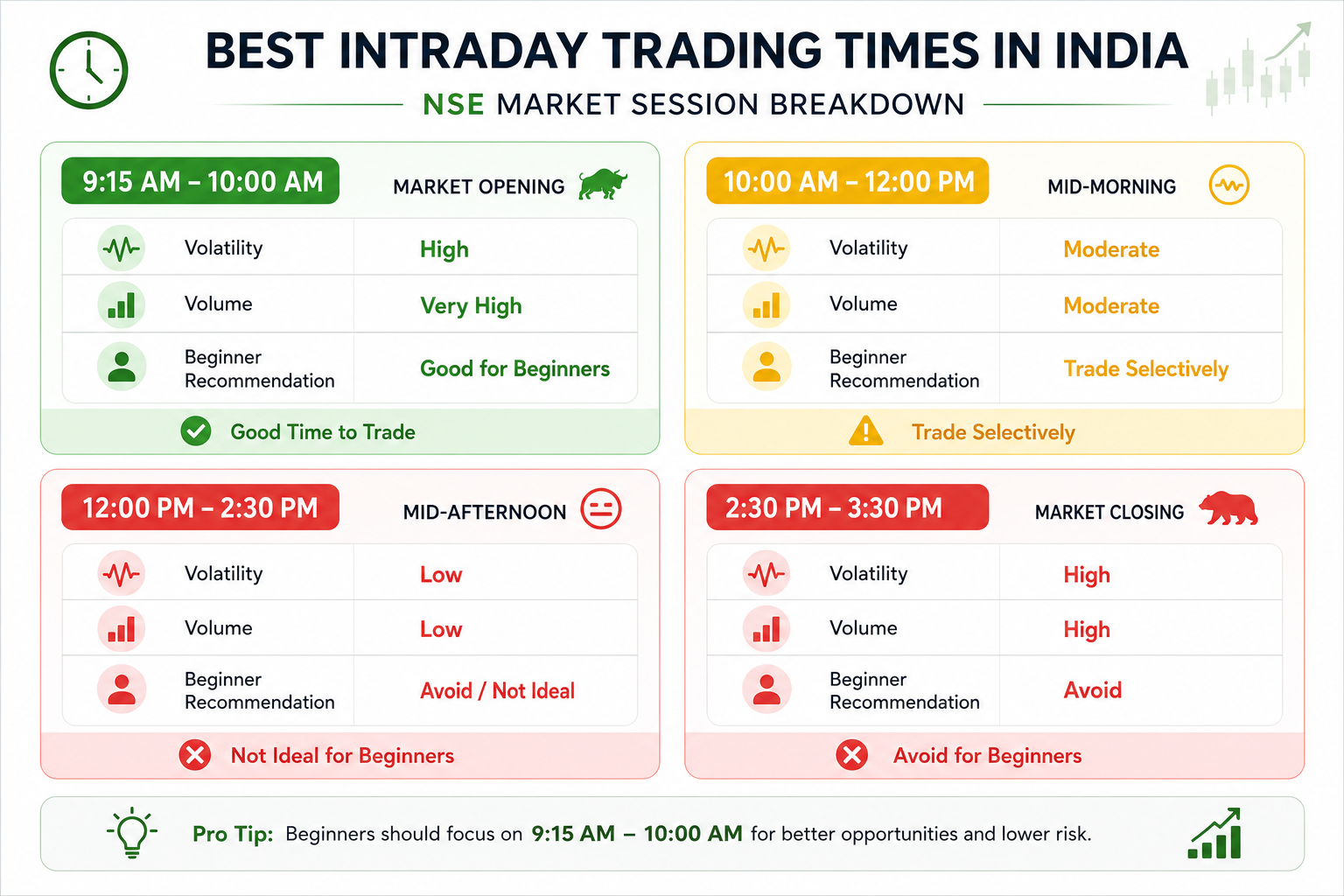
Time Periods Explained
| Period | Timing | Market Behavior | Beginner Strategy |
|---|---|---|---|
| Opening | 9:15-9:45 AM | Very high volatility, big moves in first few minutes | Avoid trading. First 10-15 min usually chaotic. Most breakout false hote hain. |
| Mid-Morning | 9:45-11:30 AM | Trend sets, decent moves, good liquidity | Better for entry. Trend clear ho jata hai. Volume decent. |
| Late Morning | 11:30 AM-1:00 PM | Sometimes choppy/range-bound, lower moves | Selective only. Clear setup na dikhe to skip. |
| Afternoon | 1:00-2:30 PM | Often slow, low volatility, traders nap time | Avoid. Don’t force trades. Best trades skip nahi karte. |
| Closing | 2:30-3:30 PM | Volatility can increase again, some good setups | Possible, but risky. Position ko overnight hold risk. Best to exit before 3:20 PM. |
One Simple Beginner Strategy: Trend + VWAP + Support/Resistance
Kyu ye strategy? Simple hai, indicators kam, rules clear hain, emotional decisions kam hote hain.
Step-by-Step
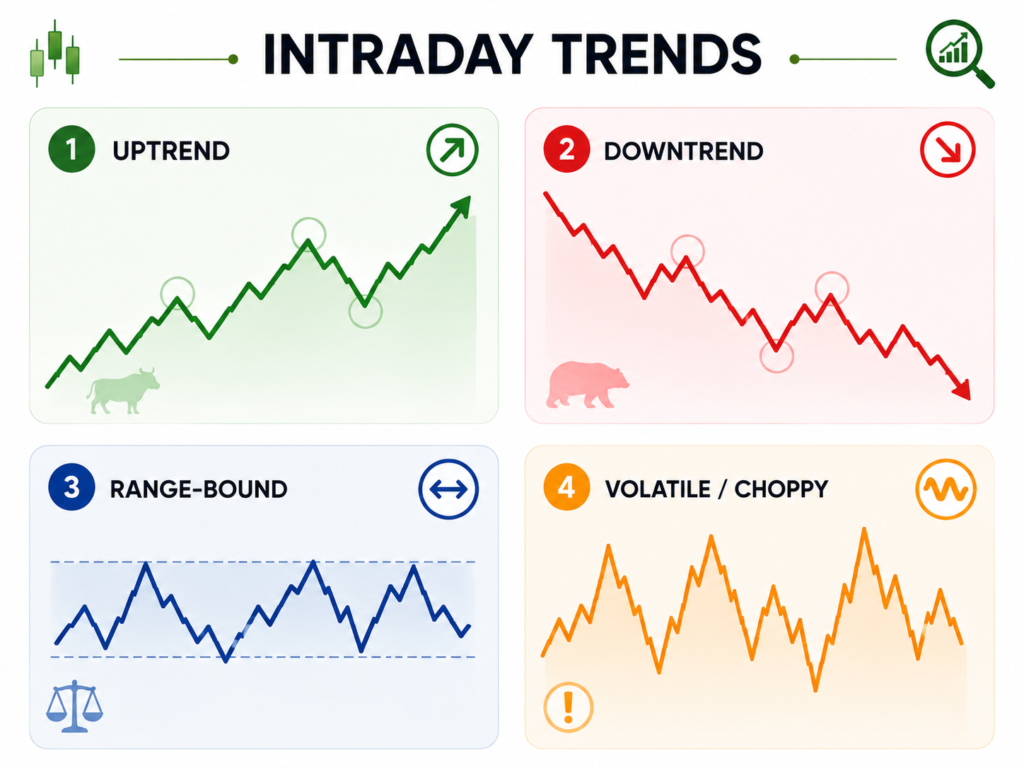
Step 1: Identify Intraday Trend
- 5-minute chart dekho
- Pichle 30 minutes ka trend dekho (higher highs + higher lows = uptrend; lower highs + lower lows = downtrend)
- Kya stock generally upar ja raha ya neeche?
Step 2: VWAP Use Karo as Context
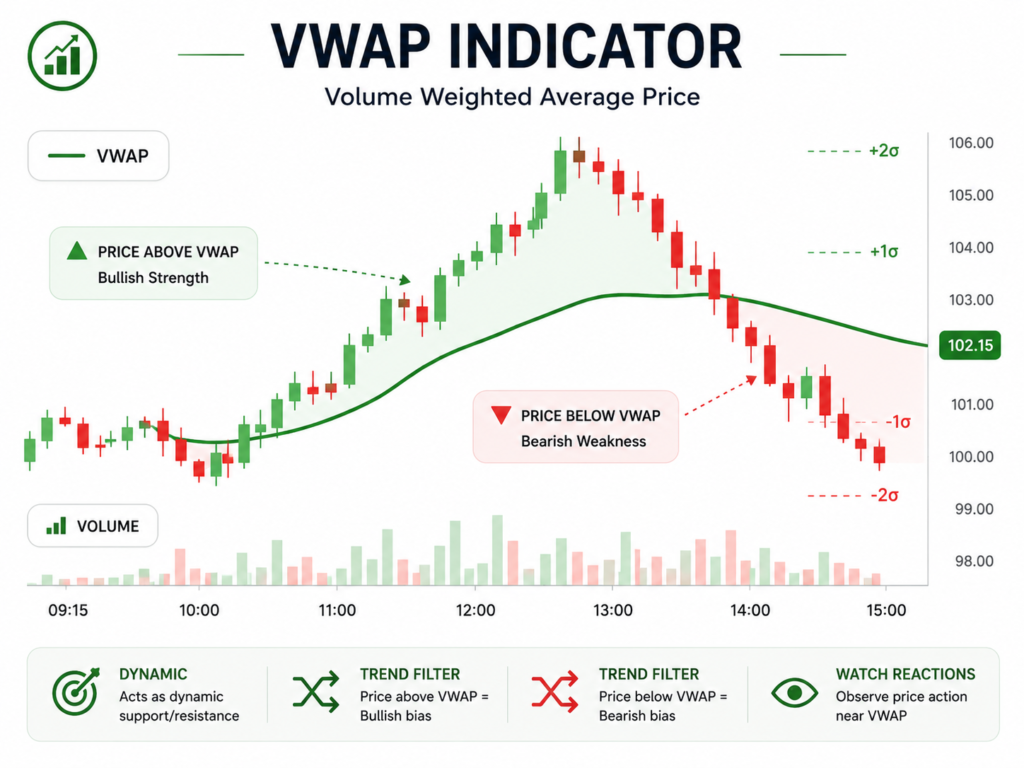
- VWAP = Volume-Weighted Average Price
- Agar price VWAP se upar hai → buyers control kar rahe, uptrend likely
- Agar price VWAP se neeche hai → sellers control kar rahe, downtrend likely
- VWAP acting as dynamic support/resistance
Step 3: Mark Support & Resistance
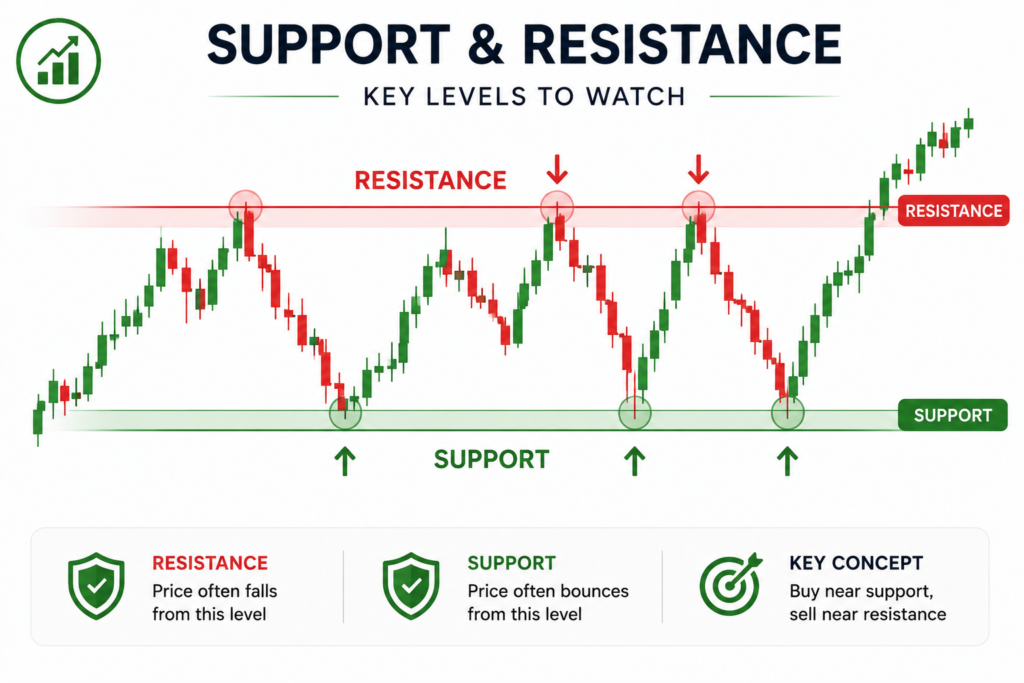
- Support = price yahan par rukti hai (lower hone se)
- Resistance = price yahan par rukti hai (badhne se)
- Last 30-60 minutes mein multiple touch wali levels mark karo
Step 4: Wait for Confirmation
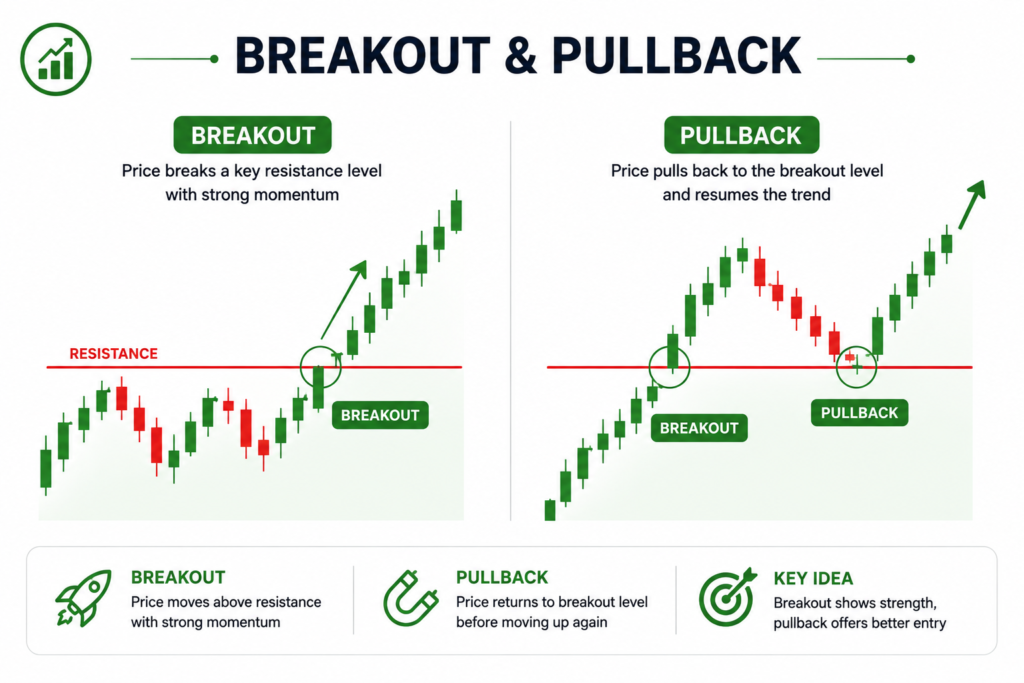
- Entry random nahi — clear price action chahiye
- Breakout setup: Price support/resistance tod kar jaaye with volume
- Pullback setup: Price trend ke against jaye, phir trend ki taraf wapas aaye
Step 5: Define Stop-Loss BEFORE Entry
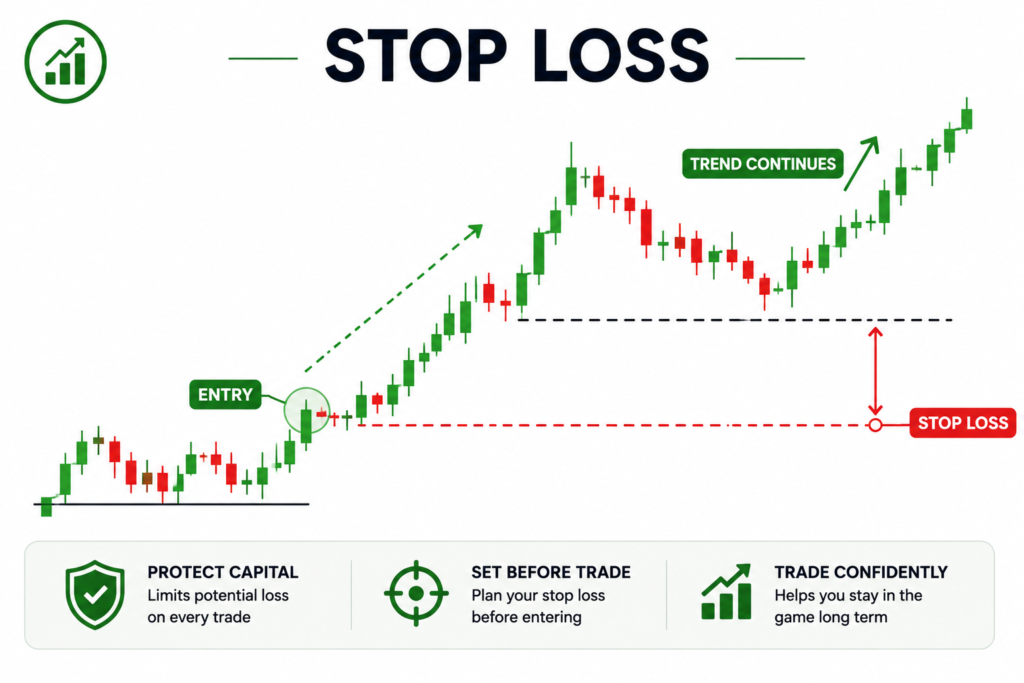
- Agar aap long jao (buy karo) → Stop-Loss recent swing low se thoda neeche
- Agar short jao (sell karo) → Stop-Loss recent swing high se thoda upar
- Risky stops avoid karo
Step 6: Set Logical Target
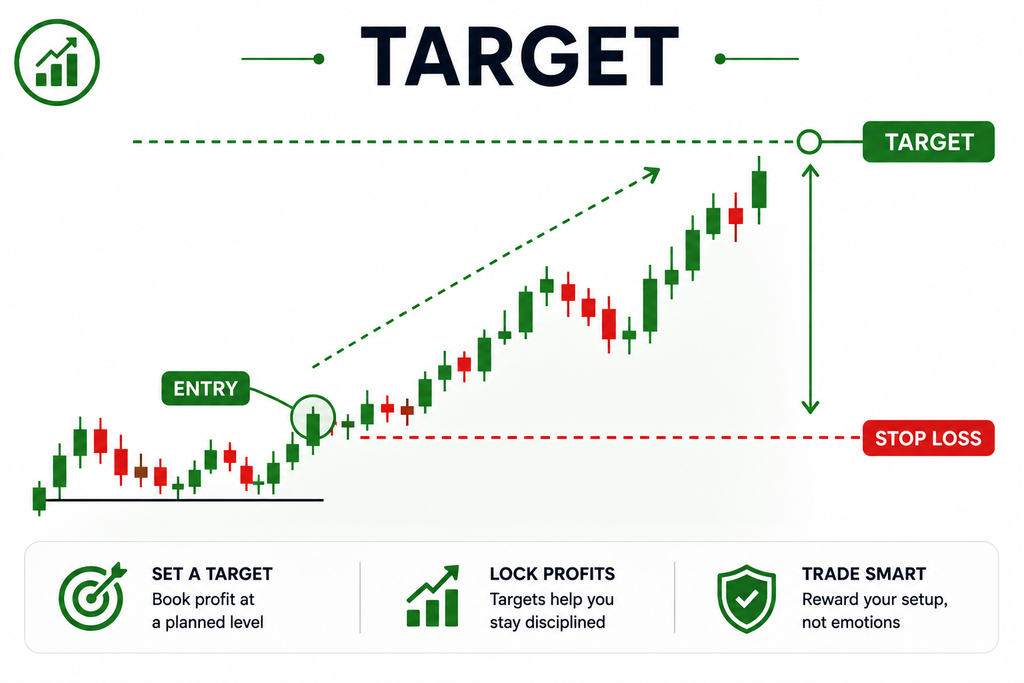
- Profit target = next significant resistance (long ke liye) ya support (short ke liye)
- Ya fir: Risk × 2 = Target (1:2 risk-reward)
Step 7: Calculate Risk-Reward
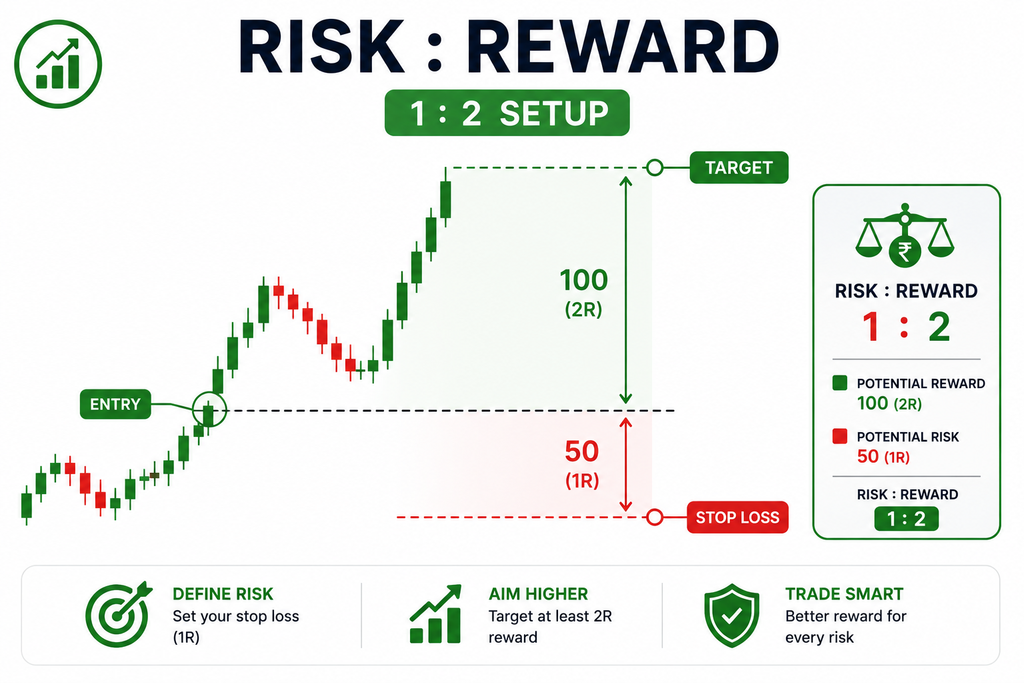
- Agar risk-reward 1:2 se kam hai → trade skip karo
- Kyu? Kyunki agar 50% trades win bhi ho, tab bhi profitable rah sakte ho (1:2 ratio se)
Step 8: Exit Per Plan
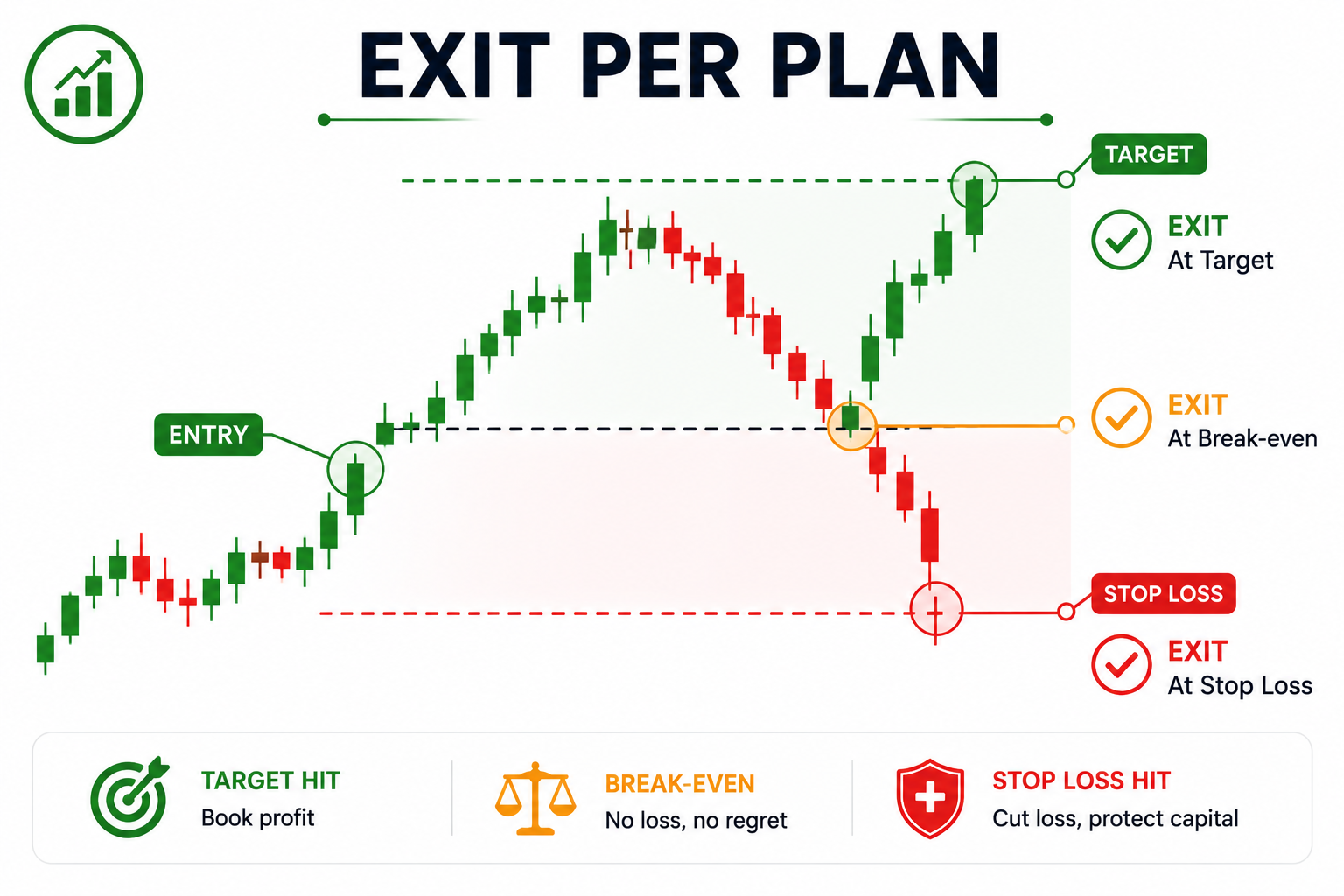
- Target hit → exit
- Stop-loss hit → exit
- Setup invalid → exit
- Session close → exit
NO mid-trade changes, NO moving stop-loss, NO averaging down.
Basic Indicators Explained
DO NOT OVERLOAD. Beginners usually 15+ indicators laga dete hain — useless hota hai.
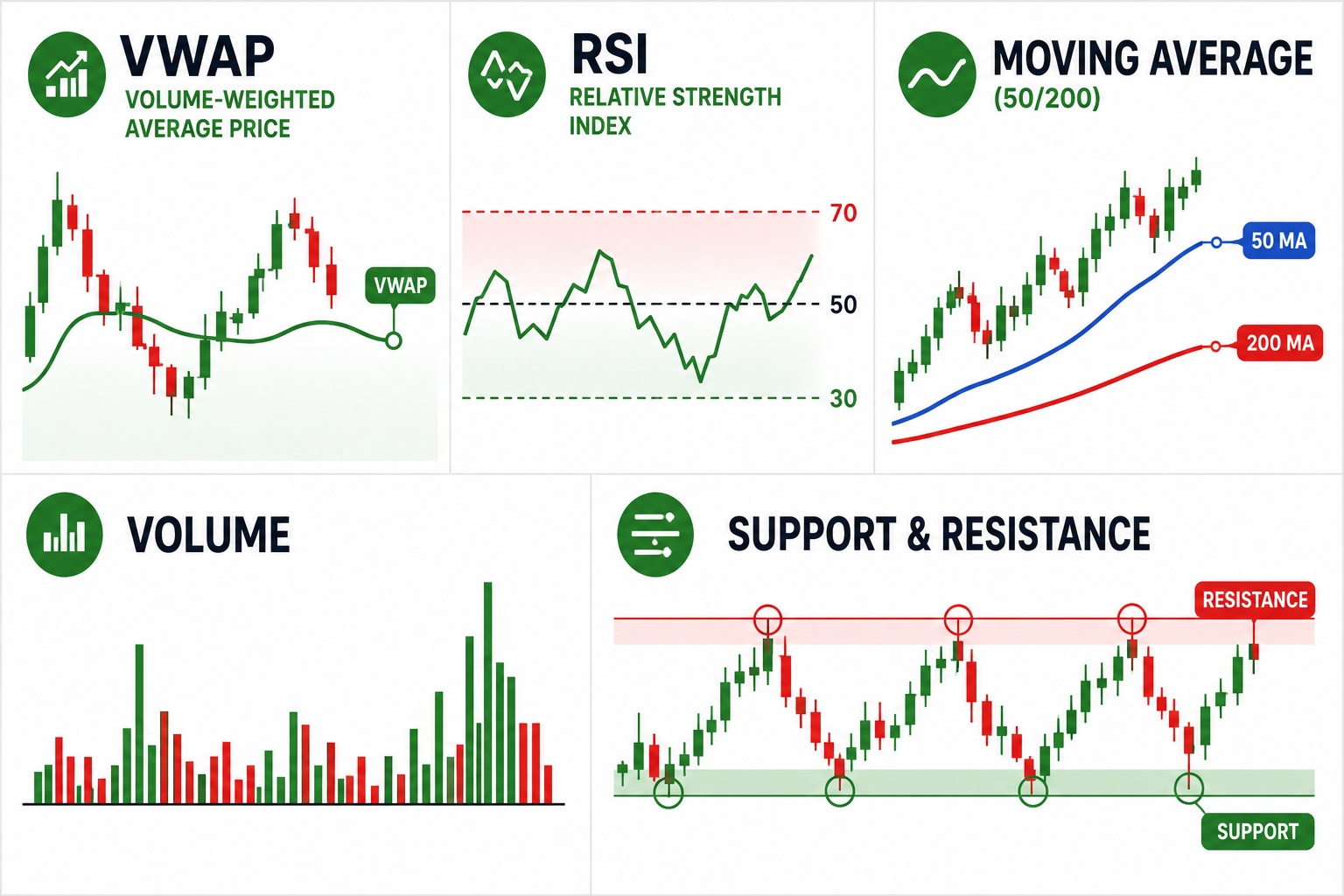
VWAP (Volume-Weighted Average Price)
- Kya hota hai: Price ka average jo volume ke base par calculated hota hai
- Kya batata hai: Institutional buyers/sellers kahan active hain
- Use: Support/resistance ke basis par
RSI (Relative Strength Index)
- Kya hota hai: Momentum indicator (0-100)
- Kya batata hai: Overbought (70+) / Oversold (30-) conditions
- Use: Extreme conditions mein caution; overconfident entries avoid karne ke liye
- NOT a buy/sell signal alone
Moving Average (50/200)
- Kya hota hai: Average closing price last N days ka
- Kya batata hai: Long-term trend direction
- Use: Context — kya price average se upar ya neeche?
Volume
- Kya hota hai: Kitni shares trade hui
- Kya batata hai: Price move genuine hai ya fake
- Use: Breakout with high volume = strong; breakout with low volume = weak
Support & Resistance
- Support: Price yahan se bounce karti hai (jeb nahi)
- Resistance: Price yahan rok di jaati hai (ceiling)
- Use: Entry/exit/stop-loss levels
“Aapko chart par 10 indicators lagane ki zaroorat nahi hai. VWAP + Trend + Support/Resistance = enough.”
Entry Rules Checklist
Bina ye checklist complete kiye entry mat lo:
- [ ] Clear setup? — Entry signal obvious hai?
- [ ] Trend identified? — Direction jaano
- [ ] Support/Resistance marked? — Key levels clear hain?
- [ ] Volume confirmation? — Moves kaafi volume ke saath hain?
- [ ] Entry price defined? — Exact entry point decide ho gaya?
- [ ] Stop-loss defined? — Exact SL price set ho gaya?
- [ ] Target defined? — Target price decide kiya?
- [ ] Risk-reward checked? — Minimum 1:1, ideally 1:2+?
- [ ] Position size calculated? — Quantity sahi hai?
- [ ] No emotional/FOMO entry? — Rational decision hai, panic nahi?
Agar ek bhi box unchecked hai → entry mat lo. Esa setup jaldi aayega.
Exit Rules: Non-Negotiable
Exit WHEN:
- Stop-loss hit → Loss book karo, move on
- Target hit → Profit lo, happy exit
- Setup invalid → Original reason se trade nahi rahi → exit
- Market conditions change → Trend reverse, volume dry up → exit
- Session end → Intraday hai, overnight risk avoid karo → exit before 3:20 PM
Exit NEVER:
- ❌ Moving stop-loss farther to avoid loss
- ❌ Averaging down (buy more when losing)
- ❌ Holding hoping for recovery
- ❌ Changing target mid-trade
- ❌ Leaving it open overnight
One hardest truth: Intraday traders jo successful hote hain, unka entry nahi, exit discipline famous hota hai.
Risk-Reward Ratio Explained
Simple Example
Risk = ₹100 (stop-loss se entry tak)
Potential Reward = ₹200 (entry se target tak)
Risk-Reward Ratio = 1:2
Kya ye mean karta hai?
- Agar 10 trades lete ho aur 5 jite, 5 hare
- Losses: 5 × ₹100 = ₹500
- Profits: 5 × ₹200 = ₹1,000
- Net = +₹500 (despite 50% win rate)
Important:
“Ek favorable risk-reward ratio by itself profitable nahi banata. Execution, entry quality, discipline sab matter karte hain.”
Lekin minimum 1:2 ratio maintain karna zaroori hota hai kyunki:
- High variance early on
- Beginner win-rate kaafi low hota hai (30-40%)
- Brokerage/taxes cut karti hain
- 1:2 ratio+ chahiye sirf breakeven ke liye
Overtrading: The Silent Account Killer
Kya hote hain overtraders?
Ek beginner sochta hai: “Ek trade profitable hote ₹500 + another trade ₹500 + another ₹500 = ₹1,500 daily.”
Real scenario:
- Trade 1: ₹200 profit ✓
- Trade 2: ₹150 profit ✓
- Trade 3: ₹100 loss (lower quality setup)
- Trade 4: ₹500 loss (after loss, revenge mode)
- Trade 5: ₹300 loss (panic closing)
- Daily brokerage/charges: ₹50
- Net = -₹600 loss (despite 2 winning trades)
Overtrading Warning Signs
- Taking 5+ trades per day
- Entering immediately after exit
- Trading out of boredom (best decision: sit out)
- Trying to recover losses immediately
- Increasing quantity after losses
- Taking every “possible” setup vs “high-quality” setup
Revenge Trading: The Psychology Trap
The Cycle
Trade 1: Loss ₹300
↓
Trader thinks: "Next trade ₹500 earn kar dunga"
↓
Trade 2: Loss ₹700 (setup marginal tha)
↓
Trader panics: "Mera plan wrong? Ab 2 times quantity"
↓
Trade 3: Loss ₹1,400
↓
Account now ₹18,300 (₹20,000 se start kiya)
↓
Spiral starts...
Why It Happens
- Emotional pain of loss
- Need to recover immediately
- Loss of objectivity
- Increased risk-taking
Prevention
- Pre-define maximum daily loss (e.g., ₹500)
- Once hit → stop trading for the day
- Walk away, cool down, review journal
- Comeback tomorrow with clear mind
10 Rules Every Beginner Should Follow
1. Trade with RISK CAPITAL ONLY
- Money you can afford to lose completely
- Not salary, loan, or investment corpus
2. Define Maximum Daily Loss
- E.g., ₹500 per day
- Once hit → stop trading for that day
- Non-negotiable
3. Never Enter Without Stop-Loss Planned
- Before entry, SL must be fixed
- Exact price, exact quantity implications
4. Never Chase a Missed Trade
- Missed 1% move? Let it go
- Better trade waiting
- FOMO kills accounts
5. Don’t Revenge Trade
- Loss happened → sit out
- Don’t try to recover same day
- Revenge trades 80% fail
6. Don’t Overtrade
- Quality > Quantity
- 2-3 high-quality trades > 10 marginal trades
- Best skill: knowing when NOT to trade
7. Avoid Excessive Leverage
- Some brokers offer 5-10x leverage
- Beginners should use 1x (no leverage) or max 2x
- Leverage amplifies BOTH gains AND losses
8. Don’t Follow Telegram/WhatsApp Tips Blindly
- “Buy XYZ now for ₹500”
- You have no context, no stop-loss, no plan
- Disaster waiting
- Apna plan follow karo
9. Maintain a Trading Journal
- Every trade log karo
- Reason for entry, exit, mistakes
- Review weekly
- Improvement comes from data, not gut
10. Stop Trading When Daily Loss Limit Hit
- ₹500 loss ho gaya? Aaj session over
- Discipline yeh distinguish karta hai winners ko losers se
Trading Journal: What to Record
Aapka journal aapka best teacher hota hai. Log karo:
- Date & Time
- Stock/Index (e.g., NIFTY, HDFC Bank)
- Setup (trend breakout? support bounce?)
- Entry Price
- Stop-Loss Price (+ rupee amount at risk)
- Target Price
- Quantity
- Exit Price & Time
- Profit/Loss (actual, after charges)
- Reason for Entry (trend? support? VWAP?)
- Reason for Exit (target? SL? setup invalid?)
- Emotional State (calm? panicked? greedy?)
- Mistake Made (if any)
Review every week: Pattern dikh jayega. Kaunse setups kaaam karte hain? Kaunse fail? Kab emotional hote ho? Kab best decisions lete ho?
15 Intraday Trading Mistakes Beginners Should Avoid
- Trading without a plan — entry dekh li, exit plan nahi
- Using too much capital — ₹50,000 full capital lga diya
- Excessive leverage — 5-10x leverage li
- No stop-loss defined — hope strategy
- Moving stop-loss — “Bas thoda aur rukne do”
- Averaging down losing trades — throw good money after bad
- FOMO trading — “Ye stock to upar ja raha, entry le lete hain”
- Revenge trading — loss ke baad reckless decisions
- Overtrading — 10+ trades daily
- Trading random stocks — illiquid, low volume wale
- Ignoring liquidity — mid-cap stocks, hard to exit
- Ignoring brokerage/taxes — ₹250 profit, ₹150 charges + ₹50 taxes = ₹50 net
- Following tips blindly — Telegram group se entry liya, no context
- Expecting daily income — every day profit = unrealistic
- Increasing quantity after winning streak — overconfidence trap
Brokerage, Taxes & Hidden Costs
Your net profit = Gross profit − All costs
Costs to Remember
| Cost | Typical Rate | Example (₹50,000 trade) |
|---|---|---|
| Brokerage | 0.01-0.05% | ₹5-25 |
| STT (Stock Transaction Tax) | 0.025% (buy), 0.025% (sell) | ₹25 total |
| Exchange Charges | 0.00345% | ₹2 |
| GST on Brokerage | 18% | ₹1-4 |
| SEBI Charges | Negligible | <₹1 |
Total on one round-trip trade: ₹35-60
So agar aap ₹500 banane expect kar rahe ho, but costs ₹60 cut kar rahi hain, realistic profit ₹440.
Different brokers different rates. Check with yours.
To Calculate Brokerage, Use our free Brokerage Calculator
Taxation on Intraday Trading
This is complex, and tax treatment depends on your situation.
General (2026):
- Intraday profits are treated as speculative business income (generally)
- Taxed at slab rates (not flat rate like long-term)
- If you’re “trader” (not investor), different rules apply
- Loss carry forward can happen
IMPORTANT:
- These rules change
- Tax treatment depends on trading frequency, pattern, intent
- Consult a qualified CA for your specific situation
From article perspective: Understand ki taxes hain, profits reduce, planning accordingly karo.
Paper Trading Explained
What Is It?
Simulated trading (real charts, fake money). Most brokers offer isse.
Benefits
- Learn execution process
- Test strategy risk-free
- Practice discipline
- Understand chart behavior
Limitation
Paper trading emotions reproduce nahi karta. When real money on line, psychology completely different hota hai.
Beginner recommendation: 1-2 weeks paper trading, phir ₹10,000 se real capital start, aur discipline maintain karo.
Can You Make Money Every Day From Intraday Trading?
Answer: NO
Reality
- Some days: ₹500 profit
- Some days: ₹300 loss
- Some days: ₹0 (best trade = not trading)
- Most days: Mixed
Strategy Evaluation
- Sample size: Minimum 30-50 trades before judging strategy
- Win rate: 40-50% win rate with 1:2 risk-reward = profitable
- Consistency: Impossible to win every day; focus on monthly/quarterly net
Key Mindset
“Can I make money?” = Yes, possible. “Will I make money every day?” = No, impossible. “Will I make money consistently?” = Only with 2+ years practice, discipline, emotional control.
Case Study: Rahul’s Good Trade vs Bad Trade
Trader Profile
- Capital: ₹20,000
- Max risk per trade: 1% = ₹200
GOOD TRADE: Rahul Does It Right
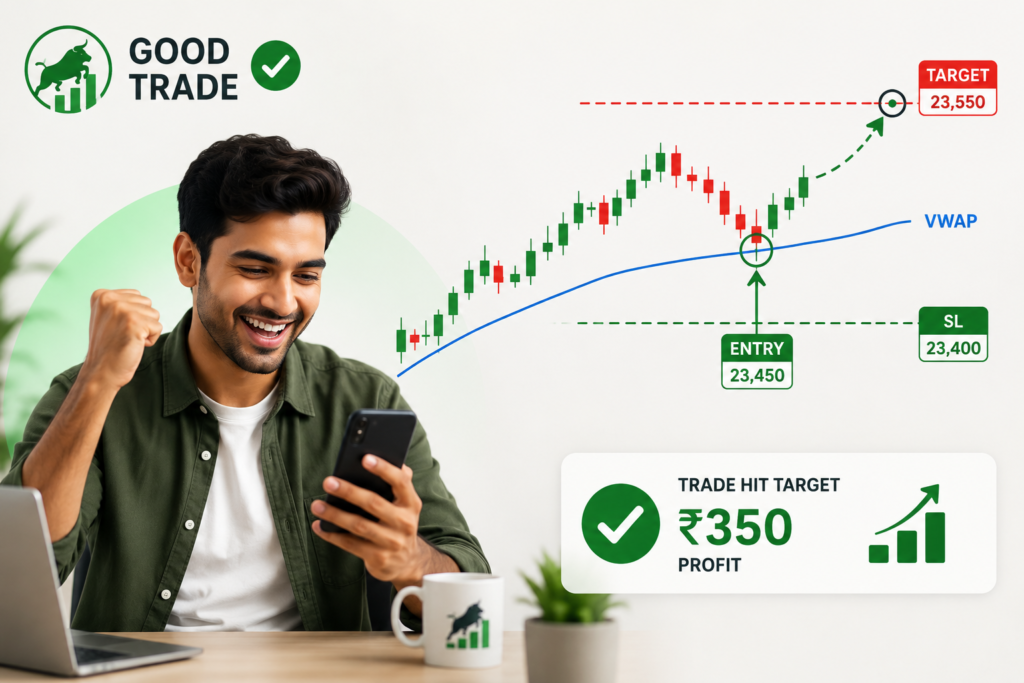
NIFTY at 9:45 AM
- Trend: Up (higher highs, higher lows last 30 min)
- VWAP: Acting as support, price above
- Resistance: 23,500
- Support: 23,400 (recent swing low)
- Setup: Price pulls back to VWAP, bounces

Entry: 23,450
Stop-Loss: 23,400 (below support)
Risk per share: ₹50 (minimum 100 quantity on indices)
Position: 4 contracts (₹200 ÷ ₹50)
Target: 23,550 (next resistance)
Potential Reward: ₹100 × 4 = ₹400

Risk-Reward: 1:2 ✓

Result: Price goes to 23,550
Profit: ₹400 − ₹50 (charges) = ₹350
Account: ₹20,350
Why good:
- Pre-planned entry/exit/SL
- Clear setup
- Risk-reward favorable
- Emotional decision nahi
- Loss calculated before entry
BAD TRADE: Rahul Ignores Rules
10:30 AM, same day

Entry: "Arre ye NIFTY neeche aa raha, mujhe short karna chahiye"
- No trend analysis
- No support/resistance marked
- No stop-loss planned
- "Quantity: Let me put ₹5,000, dekha jayega"

Entry: 23,450 (short, bina setup ke)
Stop-Loss: Undefined ("Sochenge baad mein")
Quantity: 20 contracts (overkill, no math)
Risk: Unknown, but potential: ₹2,000+ if wrong

Day of trade:
- Price actually goes UP to 23,500
- Rahul panics: "My short is losing"
- Adds more: Buys another 10 shorts at 23,500
- Now risk bigger
- Price continues up to 23,550
- Loss: ₹1,000 (₹50 × 20 original)
- Revenge trade: Tries one more
- Another ₹300 loss
- Session ends with ₹1,300 loss

Account: ₹18,700 (₹20,000 – ₹1,300)
Psychology: Demoralized, angry
Why bad:
- No planning
- Emotional entry
- Averaging down (added shorts)
- No stop-loss = unlimited loss
- Revenge trade = disaster
If I Were Starting Intraday Trading Today: 4-Week Roadmap
Week 1: Foundation Learning
- Day 1-2: What is intraday trading, brokers, account opening
- Day 3-4: Chart reading basics, support/resistance, trend identification
- Day 5-7: Risk management, position sizing, stop-loss importance
- Action: Open Demat + Trading account (if not done)
Week 2: Chart & Technical Deep Dive
- Day 8-10: VWAP, RSI, volume, moving averages in depth
- Day 11-12: Practice chart reading on historical data
- Day 13-14: Define YOUR strategy (not copy-paste)
- Action: Finalize 1 simple strategy (Trend + VWAP + S/R)
Week 3: Paper Trading
- Day 15-21: Paper trade your strategy daily
- Track every trade in journal
- NO real money yet
- Goal: 20+ paper trades
- Review patterns, win-rate, emotional triggers
- Action: If paper trading profitable (5+ days in a row positive), proceed
Week 4: Small Real Money
- Day 22-28: Real capital (₹10,000-₹15,000 only)
- Same strategy, same position sizing
- Track journal meticulously
- Review daily, adjust if needed
- Action: If profitable, scale; if losses, drill down on mistakes before scaling
Pre-Trade Checklist (Final)
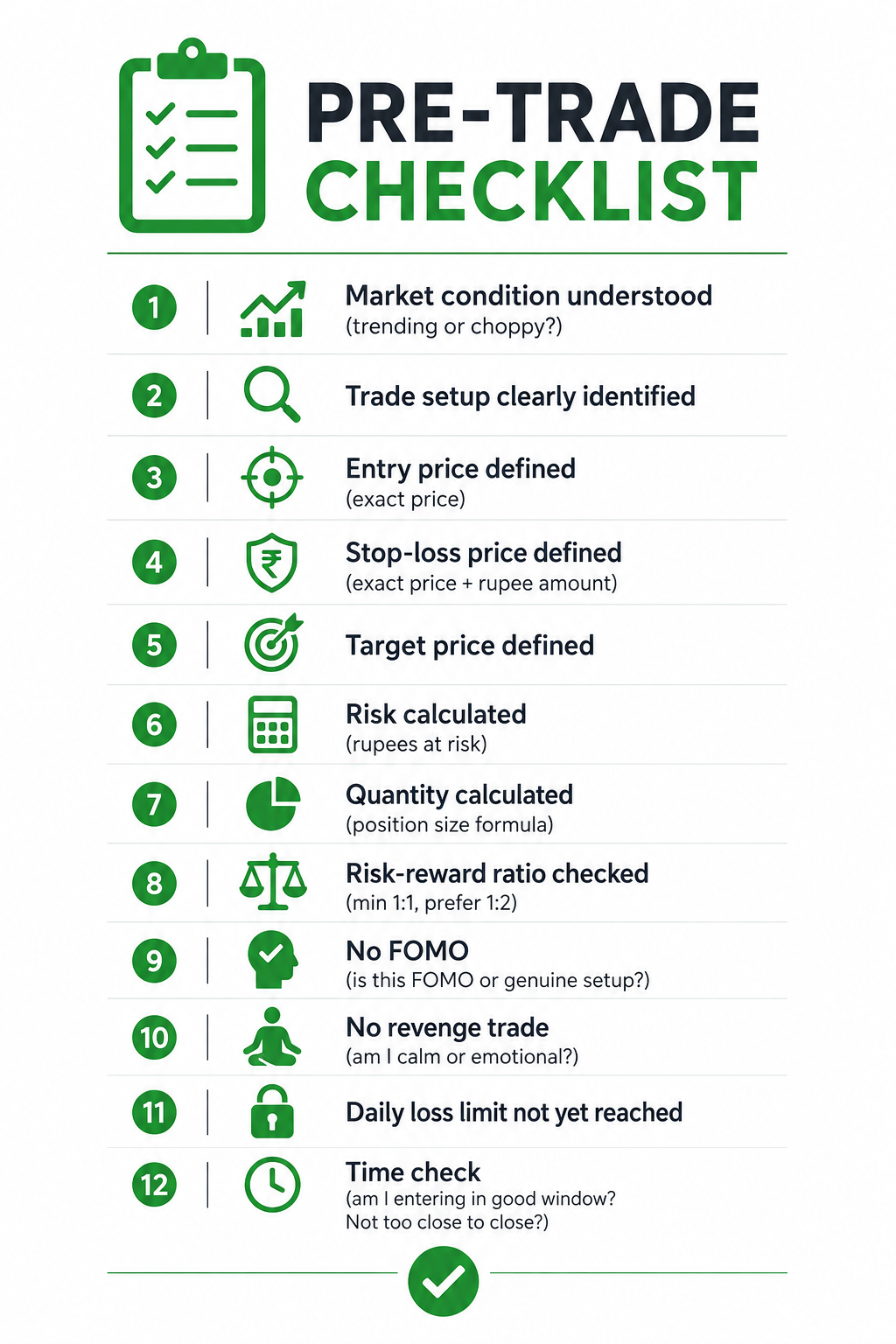
If ANY box unchecked → SKIP THE TRADE.
- NSE India – Official Website — for market data, circulars, and official market-timing/holiday updates
- BSE India – Official Website — the other primary exchange referenced in the article
- SEBI – Securities and Exchange Board of India — the regulator; good for the “verify current rules” disclaimer link
- SEBI Investor Website — SEBI’s dedicated investor education portal (beginner-friendly, matches your article’s tone)
- Income Tax Department e-Filing Portal — for the taxation section, where readers should verify current speculative-income tax treatment and ITR-3 filing rules
FAQ
1: What is intraday trading in simple terms?
Buy and sell (or short and cover) within the same trading day. Position closes by end of day.
2: Is intraday trading good for beginners?
It’s possible, but high-risk. 80% beginners lose first 3-6 months. Requires discipline, risk management, and consistency.
3: How much money is needed to start intraday trading?
No legal minimum, but practically ₹10,000-₹25,000 is good starting point for learning. Money you can afford to lose.
4: What is the best time for intraday trading in India?
10:00 AM – 2:00 PM generally best for beginners. Clear trends, good volume, less chaotic than opening.
5: Can I start intraday trading with ₹10,000?
Yes, but realistic daily profit ₹100-200 (after charges/taxes) if good. Not “₹1,000 daily.”
6: Which is the best intraday strategy for beginners?
Trend + VWAP + Support/Resistance. Simple, rules-based, less indicators = less confusion.
7: Is intraday trading risky?
Extremely. You can lose your entire capital. This is not investing; it’s active, high-risk trading.
8: How many trades should a beginner take per day?
1-3 quality trades > 10 marginal trades. Quality over quantity.
9: What is stop-loss in intraday trading?
Pre-defined price where you exit to limit losses. E.g., “If price drops below ₹499, I exit.” Protects capital.
10: What is risk-reward ratio?
Potential loss vs potential gain. E.g., risk ₹100, gain ₹200 = 1:2 ratio. Need favorable ratios to offset losses.
11: Is paper trading useful?
Useful for learning mechanics and testing strategy, but emotions in real money are different. Use for 2-3 weeks max.
12: Can I make money every day from intraday trading?
No. Some days loss, some days profit, some days best decision is not trading. Evaluate monthly/quarterly, not daily.
13: Is intraday trading better than investing?
Different. Intraday = active, high-risk, short-term. Investing = passive, lower-risk, long-term. Beginners usually better at investing.
14: What are the biggest mistakes beginners make?
No plan, no stop-loss, revenge trading, overtrading, excessive leverage, ignoring taxes/charges, following tips blindly.
15: Do I need to watch markets all day?
Yes, for intraday. You need to monitor positions. If can’t watch 3+ hours, don’t do intraday.
FINANCIAL DISCLAIMER
This article is for educational purposes only and should not be considered personalized financial or investment advice. Intraday trading involves substantial risk of loss, including the possibility of losing more than your initial investment. Past performance is not indicative of future results. Before engaging in intraday trading, you should:
- Understand the risks involved
- Ensure you can afford to lose the capital
- Consult with a qualified financial advisor for your specific situation
- Be aware of tax implications
- Research and choose a SEBI-registered broker
- Start small and learn thoroughly before scaling
The strategies and examples in this article are for illustration only and not a recommendation to buy/sell any specific security.