
TV ya social media par aapne suna hoga — “XYZ company ka IPO aa raha hai” ya “IPO oversubscribed ho gaya.” Lekin actual mein IPO hota kya hai? Company IPO kyun laati hai? Investor IPO mein apply kaise karta hai? Aur shares allot hue ya nahi, ye kaise check karte hain?
Agar aapke mann mein ye sab sawaal hain, to aap sahi jagah par hain. Is article mein hum IPO kya hota hai ye samjhenge, saath hi poori IPO journey cover karenge — samajhne se lekar apply karne, allotment check karne aur listing tak. Sab kuch simple Hinglish mein, bina kisi mushkil jargon ke.
Ek baat pehle hi clear kar dein — ye article sirf education ke liye hai. Ye kisi specific IPO mein invest karne ki salah nahi hai, aur IPO investments mein market risk hota hai jo hum aage detail mein discuss karenge.
Table of Contents
1. IPO Kya Hota Hai?
Simple bhasha mein samjhein — IPO ek process hai jisme ek unlisted company pehli baar apne shares public investors ko offer karti hai aur stock exchange par list hone ki process complete karti hai.
“Unlisted” ka matlab hai ki company ke shares abhi kisi stock exchange (jaise BSE ya NSE) par trade nahi hote. Aisi companies ke shares aam taur par sirf founders, promoters, family, aur select investors (jaise venture capitalists) ke paas hote hain. Aam retail investor chahe bhi to us company mein directly invest nahi kar sakta — kyunki uske shares kharidne ka koi public marketplace exist hi nahi karta.
Jab company IPO laati hai, to woh apne shares ka ek hissa public ko offer karti hai. Eligible investors us IPO mein apply kar sakte hain aur company ke partial owner ban sakte hain.
Ek chhota sa example lete hain:
Suppose ek company ko business expand karne ke liye ₹1,000 crore chahiye. Ye paisa woh bank se loan lekar bhi utha sakti hai, lekin loan par interest dena padta hai. Iski jagah company IPO launch karti hai — apne shares public ko bechkar directly market se paisa raise karti hai. Is paisay se company naye plants laga sakti hai, business expand kar sakti hai, ya apna existing debt chuka sakti hai.
Jaise hi IPO complete hota hai, company ke shares stock exchange par trade hone lagte hain, aur ab eligible investors us company ke shares kharid-bech sakte hain.
2. IPO Full Form & Meaning
IPO ka full form hai — Initial Public Offering.
Chaliye ek-ek word ko break karte hain:
- Initial — Iska matlab hai “pehli baar.” Ye company ka pehla mauka hota hai jab woh apne shares public ko offer kar rahi hai.
- Public — Ye offer aam janta (general public) ke liye hai, sirf select logo ke liye nahi.
- Offering — Company apne shares “offer” kar rahi hai, matlab bechne ke liye rakh rahi hai.
Simple words mein: IPO meaning hai — ek unlisted company ka apne shares pehli baar public investors ko bechne aur stock exchange par list hone ka process.
3. Company IPO Kyun Launch Karti Hai?
Companies IPO launch karne ke peeche kai reasons ho sakte hain:
- Business expansion — naye markets mein entry, naya product launch, ya operations badhana
- Naye factories/plants — manufacturing capacity badhane ke liye
- Debt repayment — company apna existing loan chukana chahti hai
- Working capital — day-to-day business operations chalane ke liye funds
- Acquisitions — kisi doosri company ko kharidne ke liye
- General corporate purposes — overall business needs ke liye flexible funding
- Existing investors/promoters shares bechna — kabhi-kabhi company khud paisa nahi utha rahi hoti, balki existing shareholders apna stake sell kar rahe hote hain
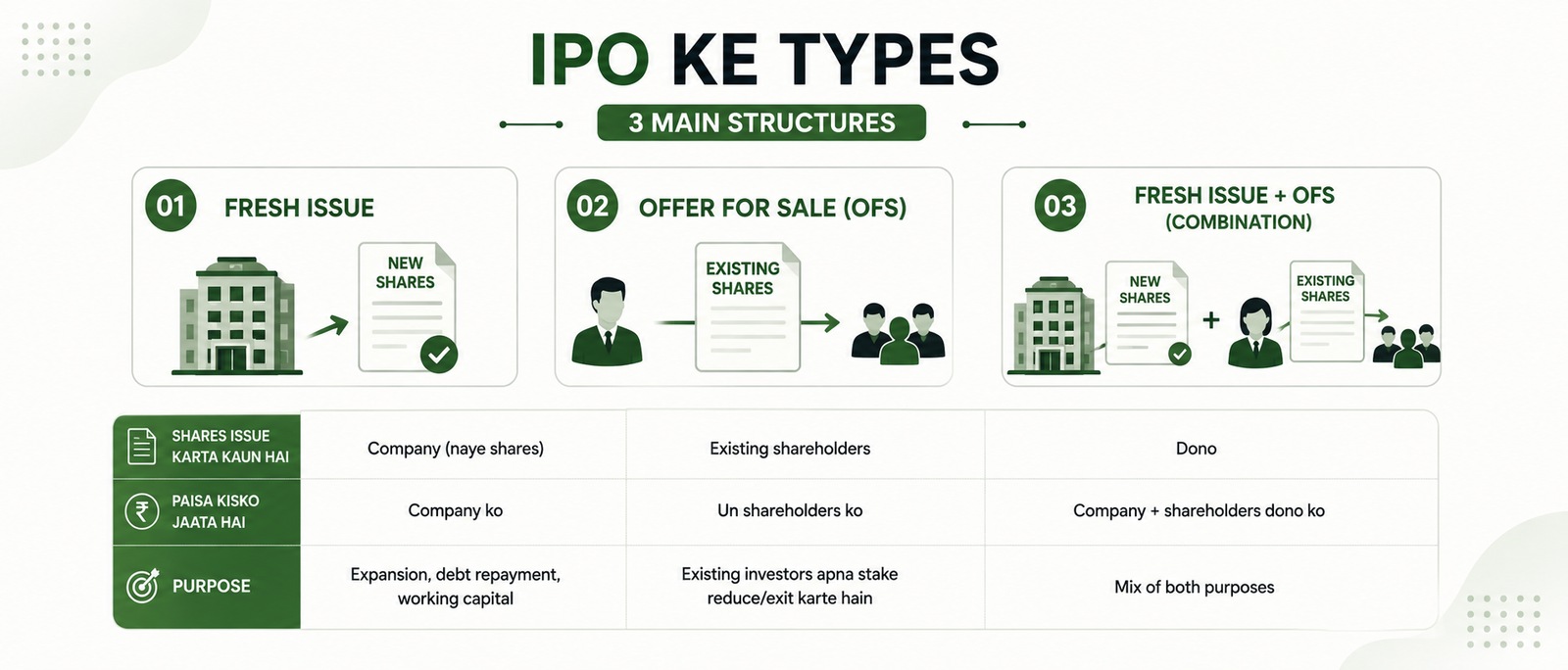
Yahan ek important baat samajhna zaroori hai — har IPO sirf business expansion ke liye nahi hota. Kuch IPOs mein company khud koi naya paisa nahi utha rahi hoti, balki existing shareholders (jaise promoters ya early investors) apne purane shares public ko bech rahe hote hain. Ise Offer for Sale (OFS) kehte hain, jo hum aage detail mein samjhenge.
4. IPO Ke Types
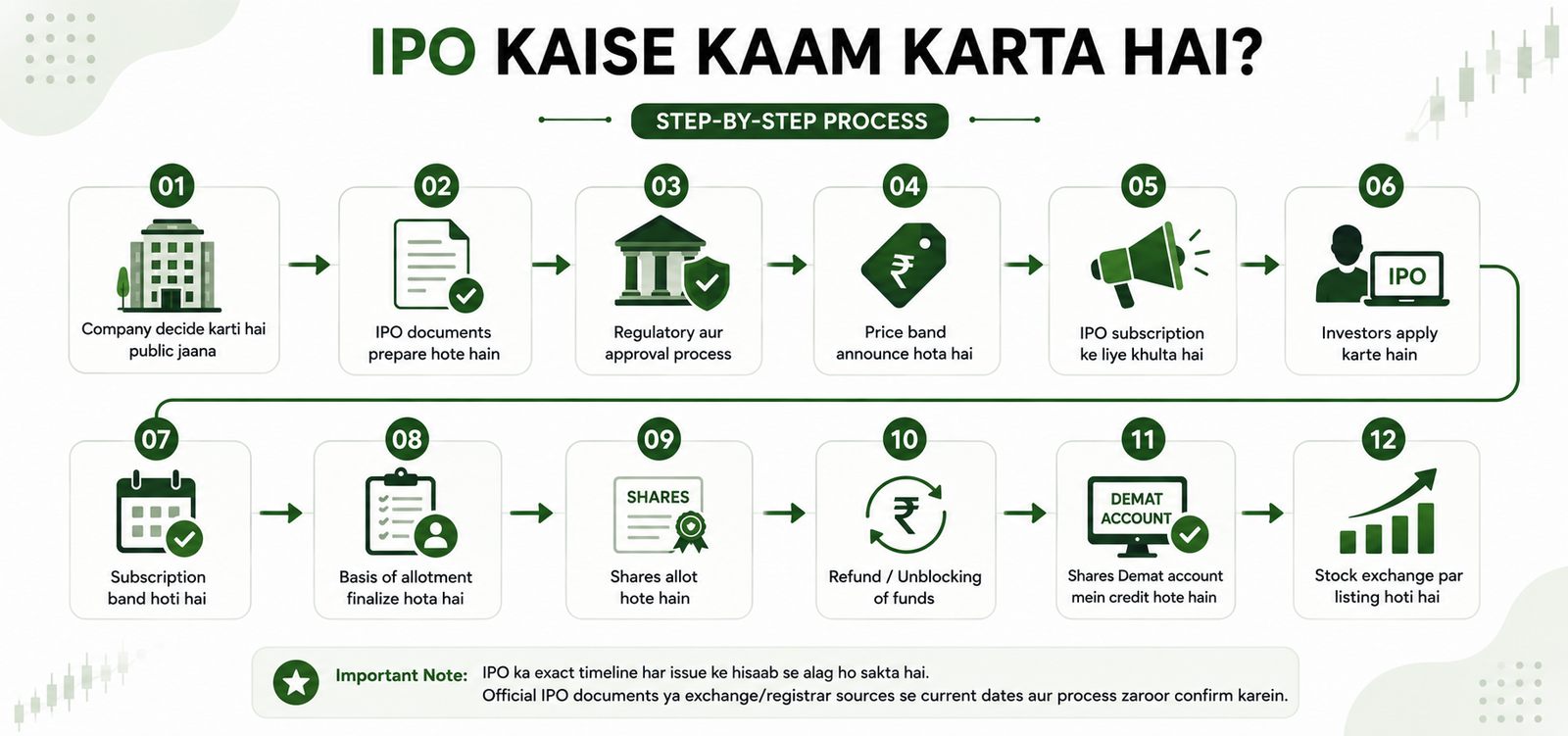
5. IPO Kaise Kaam Karta Hai?
IPO ek multi-step process hai. Chaliye ise step-by-step samjhte hain:
6. IPO Price Band Kya Hota Hai?
Jab company IPO launch karti hai, to woh ek fixed price nahi, balki ek price range deti hai — ise price band kehte hain.
- Floor Price — Price band ka sabse minimum (lower) price.
- Cap Price — Price band ka sabse maximum (upper) price.
- Price Band — Floor price aur cap price ke beech ka range.
Example samjhte hain:
Suppose ek hypothetical IPO ka price band hai ₹95–₹100.
- Yahan ₹95 floor price hai
- ₹100 cap price hai
- Investor apni bid is range ke andar kisi bhi price par laga sakta hai
Book-built IPOs mein final issue price (jise “cut-off price” bhi kehte hain) is price band ke andar hi demand ke basis par decide hoti hai — iska detailed explanation aap agle sections mein padhenge.
7. Lot Size Kya Hota Hai?
IPO mein aap seedhe “1 share” nahi khareed sakte. Investors ko ek fixed minimum quantity mein hi apply karna hota hai, jise lot kehte hain.
- Lot matlab shares ka ek predefined bundle jisme apply karna mandatory hota hai.
- Minimum application quantity ka matlab hai ki aap kam se kam 1 lot ke liye apply karte hain — usse kam nahi.
Example:
Suppose ek hypothetical IPO mein:
- Price = ₹100 per share
- Lot size = 150 shares
To minimum application amount hoga: 150 shares × ₹100 = ₹15,000
Yaad rakhein: Actual lot size aur minimum investment amount har IPO ke hisaab se alag hota hai — ye company ke price band aur regulatory guidelines par depend karta hai. Kisi bhi specific IPO ke liye lot size uske official documents mein diya hota hai.
8. IPO Mein Apply Kaise Karein?
IPO mein apply karna aajkal kaafi simple ho gaya hai, especially jab se UPI-based application process aam ho gaya hai. General process kuch is tarah hota hai (exact steps platform ke hisaab se thoda alag ho sakte hain):
- IPO details check karein — Price band, lot size, dates, aur company details dekhein.
- Apna broker app ya platform open karein — Jahan aapka Demat/trading account hai.
- Relevant IPO select karein jo currently subscription ke liye open hai.
- Investor category choose karein — jaise Retail Individual Investor (RII).
- Lot quantity enter karein — Kitne lots ke liye apply karna hai.
- Bid price enter karein ya “cut-off” option select karein, jahan applicable ho — iska matlab hai ki aap final issue price accept karne ke liye tayar hain.
- Apna UPI ID enter karein jo application ke saath link karna hai.
- Application submit karein.
- UPI mandate approve karein — Aapke UPI app par ek request aayegi jise time par approve karna hota hai.
- Application status check karte rahein taaki confirm ho sake ki application successfully register hui hai.
Iska underlying mechanism — ASBA aur UPI mandate kaise kaam karte hain — agle section mein detail mein samjhaya gaya hai.
9. ASBA & UPI Se IPO Application Kaise Kaam Karti Hai?
IPO applications mein zyada tar paisa turant debit nahi hota. Iski jagah ek mechanism use hota hai jise ASBA (Applications Supported by Blocked Amount) kehte hain, jo aaj retail investors ke liye generally UPI mandate ke through operate hota hai.
Simple flow samjhein:
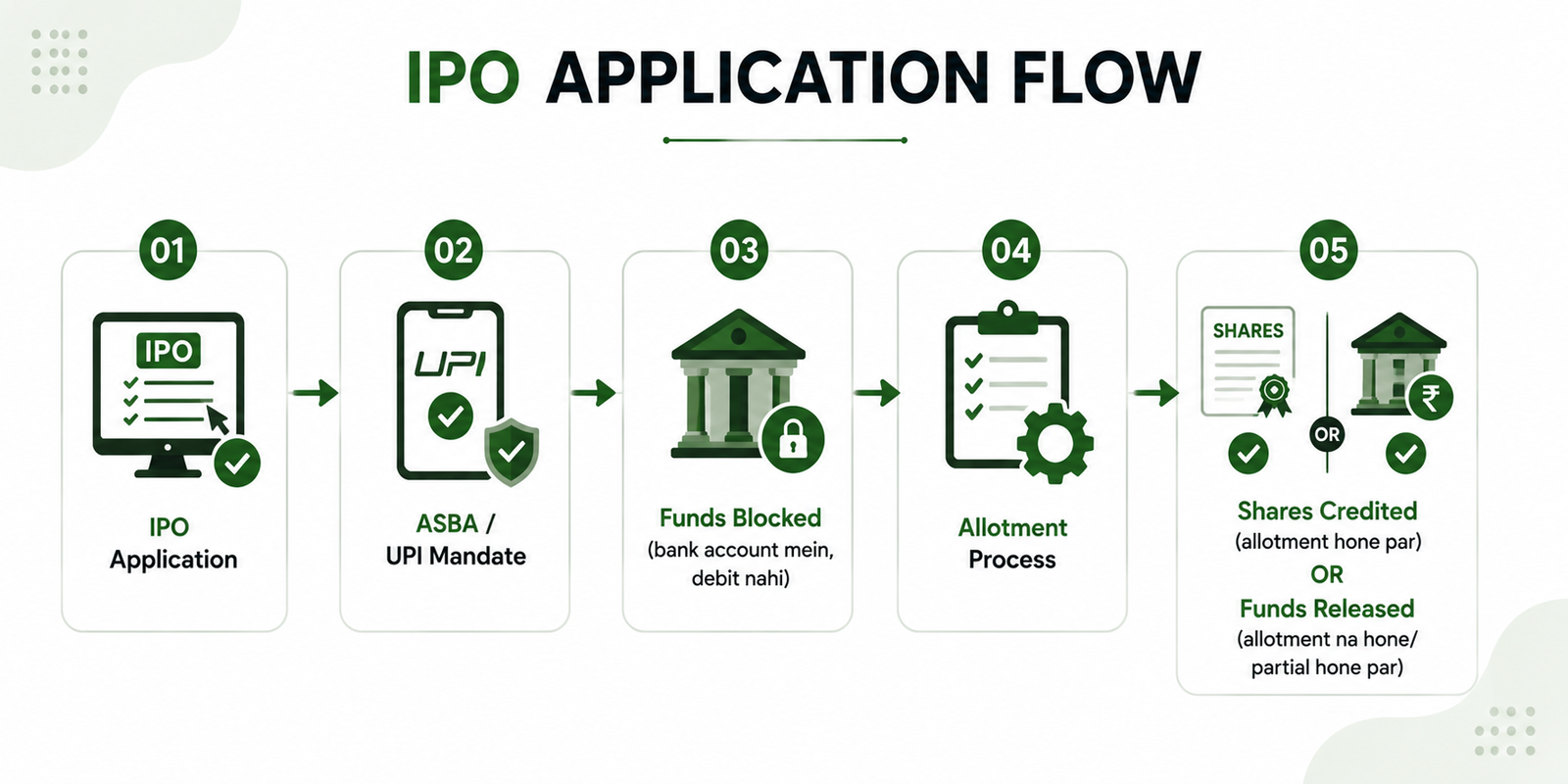
Iska matlab hai:
- Jab aap IPO apply karte hain, to application amount aapke bank account mein sirf block hota hai, turant debit nahi hota.
- Retail investors ke liye ye blocking generally UPI mandate approve karne se hoti hai.
- Agar aapko shares allot hote hain, to blocked amount debit ho jaata hai aur shares Demat account mein credit hote hain.
- Agar allotment nahi hota ya partial hota hai, to applicable blocked amount release/unblock ho jaata hai.
Important: Exact mechanism, category-wise process, aur applicable timelines investor category aur platform ke hisaab se vary kar sakte hain. Apne broker/bank ki current process zaroor verify karein.
10. IPO Mein Apply Karne Ke Liye Kya Chahiye?
IPO apply karne se pehle ye cheezein ready honi chahiye:
- ✅ PAN Card
- ✅ Demat Account
- ✅ Bank Account (jisme funds block ho sakein)
- ✅ Valid UPI ID / applicable payment mechanism
- ✅ Registered mobile number
- ✅ Trading/broker account, jahan applicable ho
Note: Requirements aur application methods investor category aur platform ke hisaab se alag ho sakte hain. Apply karne se pehle apne broker/bank ki current requirements zaroor check kar lein.
11. IPO Allotment Kya Hota Hai?
Allotment ka matlab hai — applicable regulatory rules aur us IPO ke liye finalize kiye gaye “basis of allotment” ke according, decide karna ki kis investor ko kitne shares milenge.
Jab IPO ki demand available shares se kam ya barabar hoti hai, to applicants ko generally unke applied quantity ke hisaab se shares mil jaate hain. Lekin jab IPO oversubscribed hota hai (matlab demand supply se zyada ho), to har applicant ko shares milna guaranteed nahi hota.
Example samjhte hain:
Suppose kisi hypothetical IPO mein sirf 1 lakh shares available hain, lekin investors ne total 5 lakh shares ke liye applications daali hain.
Is case mein demand supply se 5 guna zyada hai. Aisi situation mein registrar, applicable regulatory framework ke according basis of allotment finalize karta hai. Retail category mein, jahan zyada tar investors sirf minimum lot ke liye apply karte hain aur demand supply se kaafi zyada ho, wahan minimum-lot allotment ke liye lottery/draw-based process applicable ho sakta hai — matlab kuch applicants ko full minimum lot milta hai aur baaki ko nahi.
Ye process randomly “kisi ko partial, kisi ko full” nahi deta — balki SEBI/exchange ke defined rules ke according systematically execute hota hai. Exact methodology IPO se IPO alag ho sakti hai, isliye specific IPO ka basis of allotment document hi authoritative source hota hai.
12. IPO Allotment Status Kaise Check Karein?
Apna IPO allotment status check karne ke liye aam taur par ye options available hote hain:
Registrar Website
Har IPO ka ek registrar hota hai jo allotment process manage karta hai. Registrar apni website par generally ek “IPO Allotment Status” check karne ki facility deta hai, jahan aap apna PAN ya application number daalkar status dekh sakte hain.
Stock Exchange Website
Kai baar allotment se related information stock exchanges ki website par bhi available ho sakti hai.
On NSE :
- https://www.nseindia.com/market-data/all-upcoming-issues-ipo ,
- https://www.nseindia.com/invest/check-trades-bids-verify-ipo-bids
Broker/App
Aapka broker ya trading app bhi IPO application status ya related updates show kar sakta hai.
Important note: Exact process, available options, aur website links har IPO ke hisaab se alag ho sakte hain — kyunki har IPO ka registrar different ho sakta hai. Current allotment status hamesha us specific IPO ke official registrar ya applicable exchange source se hi verify karein.
13. Allotment Status Check Karne Ke Liye Kya Details Chahiye?
Aam taur par allotment status check karne ke liye ye information use hoti hai:
- PAN Number
- Application Number
- DP ID / Client ID (Demat account se related)
- Application ke doosre details, jaise category ya applied quantity
Note: Exact required fields registrar aur platform ke hisaab se different ho sakte hain, isliye applicable checking page par diye gaye instructions follow karein.
14. IPO Allotment Na Ho To Kya Hota Hai?
Agar aapko IPO mein allotment nahi milta, to ghabraane ki baat nahi hai — ye kaafi common hai, especially oversubscribed IPOs mein.
Yahan teen possible outcomes hote hain:
- Full Allotment — Aapko utne hi shares milte hain jitne aapne apply kiye the.
- Partial Allotment — Aapko applied quantity se kam shares milte hain.
- No Allotment — Aapko koi shares nahi milte.
Agar allotment nahi hota ya partial hota hai, to jo bhi extra paisa aapke bank account mein block kiya gaya tha (ASBA/UPI mandate ke through), woh applicable process ke through release/unblock ho jaata hai. Iske baad aap us paisay ko normally use kar sakte hain — ye permanently “chala” nahi jaata.
15. IPO Listing Kya Hoti Hai?
Allotment ke baad agla step hota hai listing.
Listing ka matlab hai — company ke shares officially stock exchange par trading ke liye available ho jaate hain. Isse pehle:
- Allotted shares aapke Demat account mein credit ho jaate hain
- Company stock exchange par listed ho jaati hai
- Ab shares exchange par buy/sell ke liye trade hone lagte hain
Ek important point samajhna zaroori hai — listing price hamesha issue price ke barabar nahi hoti.
Listing price issue price se upar, neeche, ya lagbhag barabar — kuch bhi ho sakti hai. Ye depend karta hai market demand, company ke fundamentals, aur overall market conditions par.
Hypothetical example:
Suppose issue price ₹100 hai, aur listing ke din stock ₹120 par list hota hai. Ye ek listing gain hai. Lekin ye guaranteed nahi hota — kai baar stock apne issue price se neeche bhi list ho sakta hai, jise listing loss kehte hain.
Yaad rakhein: Issue price ≠ guaranteed listing price.
16. IPO Mein Profit Kaise Hota Hai?
IPO se profit banane ke mainly do concepts hote hain:
- Listing Gains — Agar stock apne issue price se upar list hota hai, to investor short-term mein profit dekh sakta hai (agar woh listing ke aas-paas shares bech de).
- Long-term Price Appreciation — Agar company ache se perform karti hai, to uska stock price time ke saath badh sakta hai, jisse long-term investors ko fayda ho sakta hai.
Lekin IPO mein profit guaranteed nahi hai. Stock apne issue price se neeche bhi list ho sakta hai, market conditions overall price ko affect karte hain, aur long-term returns company ki actual performance par depend karte hain. IPO ek market-linked investment hai jisme risk hamesha involved hota hai.
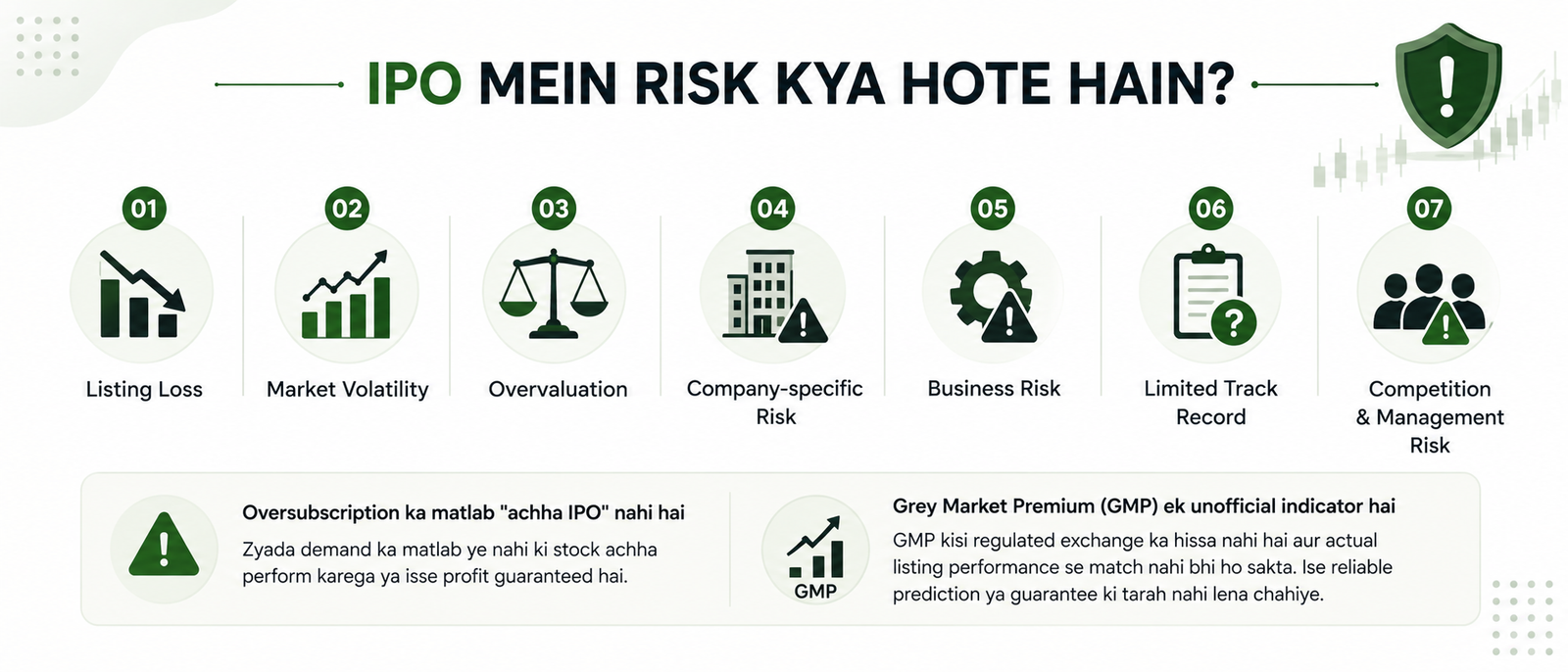
17. IPO Mein Risk Kya Hote Hain?
18. IPO Apply Karne Se Pehle Kya Check Karein?
Apply karne se pehle ye beginner checklist follow karein:
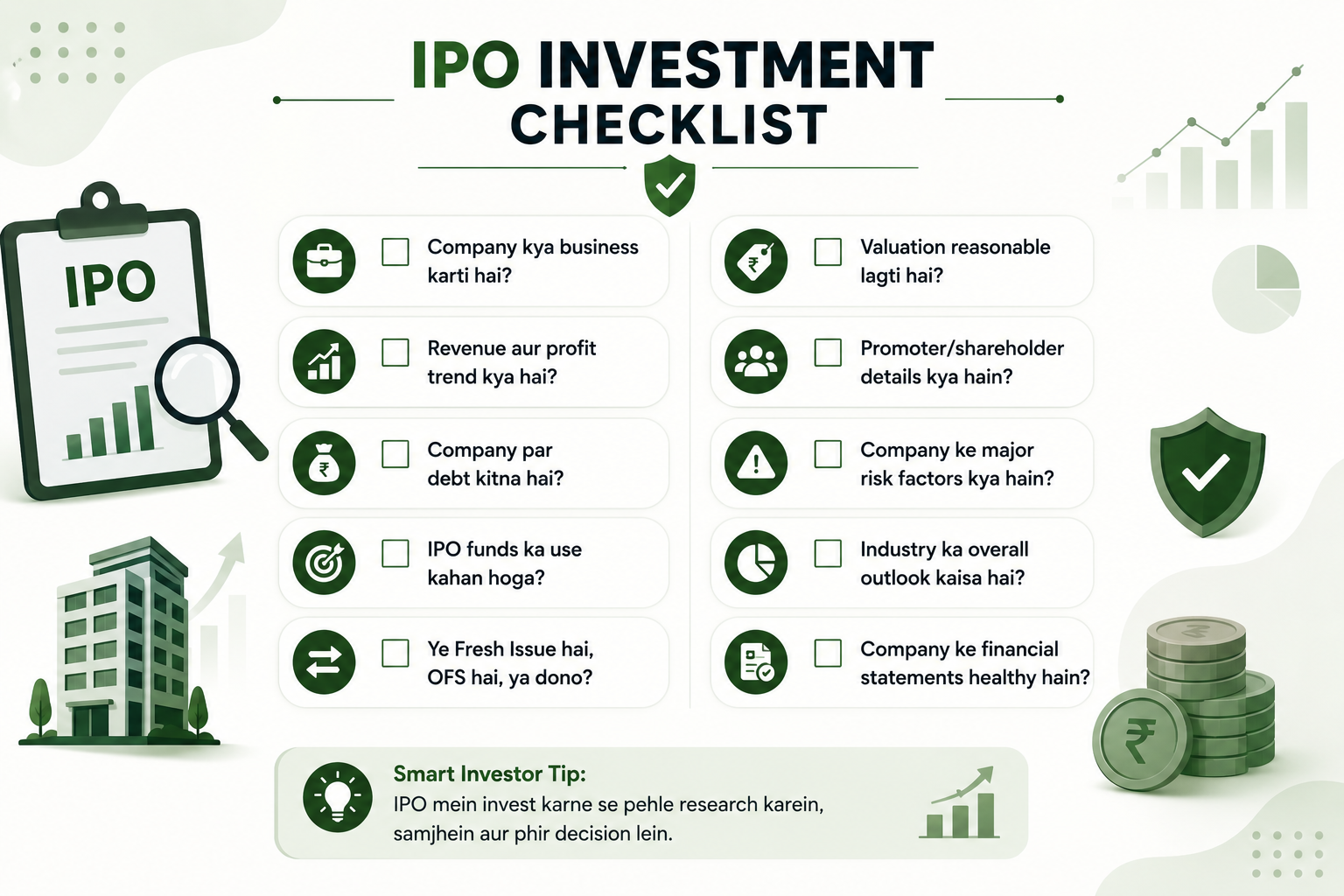
Ye sab information company ke official IPO documents jaise DRHP (Draft Red Herring Prospectus) aur RHP (Red Herring Prospectus) mein available hoti hai. In documents ko padhna time-consuming lag sakta hai, lekin ye aapko informed decision lene mein madad karta hai.
19. IPO vs FPO
IPO ke alawa aapne FPO term bhi suna hoga. Chaliye difference samjhte hain.
- IPO (Initial Public Offering) — Jab ek unlisted company pehli baar apne shares public ko offer karti hai aur stock exchange par list hoti hai.
- FPO (Follow-on Public Offering) — Jab ek already-listed company (jo pehle se hi exchange par trade ho rahi hai) additional shares public ko offer karti hai, taaki aur paisa raise kiya ja sake.
| Parameter | IPO | FPO |
|---|---|---|
| Company already listed hai? | Nahi, company pehli baar public aa rahi hai | Haan, company already exchange par listed hai |
| Kab hota hai | Company ke listing journey ka first step | Listing ke baad, jab company ko additional funds chahiye |
| Price discovery | Price band ke through naye sirre se decide hoti hai | Existing market price ke reference se decide hoti hai |
| Investor ke liye | Naye company mein pehli baar invest karne ka mauka | Already-known company mein aur shares kharidne ka mauka |
| Risk profile | Limited track record ka risk zyada ho sakta hai | Company ka past performance already public hai, isliye evaluate karna aasan hota hai |
Simple tarike se yaad rakhein — IPO “pehli baar” hota hai, FPO “dobara” hota hai.
20. Fresh Issue vs OFS
Section 4 mein humne Fresh Issue aur OFS ko individually samjha. Ab dono ko side-by-side compare karte hain, taaki difference ekdum clear ho jaaye.
| Parameter | Fresh Issue | Offer for Sale (OFS) |
|---|---|---|
| Shares issue/sell karta kaun hai? | Company naye shares issue karti hai | Existing shareholders (promoters/early investors) apne purane shares bechte hain |
| Naye shares create hote hain? | Haan | Nahi — existing shares hi transfer hote hain |
| Paisa kisko milta hai? | Company ko | Selling shareholders ko |
| Kyun kiya jaata hai? | Business expansion, debt repayment, working capital jaise purposes ke liye | Existing investors apna stake reduce/exit karna chahte hain |
| Company par effect | Company ke paas naya capital aata hai, aur equity base badhta hai | Company ke fundamentals par direct financial effect nahi hota, sirf ownership shift hoti hai |
| Example | Company 1 crore naye shares issue karke ₹100 crore raise karti hai, jo company ke account mein aata hai | Promoter apne 50 lakh existing shares bechta hai, jiska paisa promoter ko milta hai, company ko nahi |
Bohot saare IPOs mein dono elements saath mein hote hain — isliye IPO documents mein ye zaroor dekhein ki total issue size mein kitna Fresh Issue hai aur kitna OFS.
21. IPO Ke Important Terms
| Term | Simple Meaning |
|---|---|
| IPO | Ek unlisted company ka apne shares pehli baar public ko offer karne aur stock exchange par list hone ka process |
| FPO | Already-listed company dwara additional shares public ko offer karna |
| DRHP | Draft document jisme company apna business, financials aur risks disclose karti hai, regulatory review ke liye |
| RHP | DRHP ka final/updated version jo IPO ke time investors ke liye available hota hai |
| Fresh Issue | Company ke naye shares issue hote hain, paisa company ko milta hai |
| Offer for Sale (OFS) | Existing shareholders apne shares bechte hain, paisa unhe milta hai |
| Price Band | Floor price aur cap price ke beech ka range jisme investor bid laga sakta hai |
| Floor Price | Price band ka minimum price |
| Cap Price | Price band ka maximum price |
| Lot Size | Minimum shares quantity jisme apply karna mandatory hota hai |
| Cut-off Price | Final issue price jo price band ke andar demand ke basis par decide hoti hai; retail investors “cut-off” option choose karke is final price par subscribe karne ke liye agree karte hain |
| Subscription | IPO ke liye applications receive hone ka process |
| Allotment | Applicable rules ke according decide karna ki kis investor ko kitne shares milenge |
| Registrar | Wo entity jo IPO application aur allotment process manage karti hai |
| Listing | Shares ka stock exchange par trading ke liye available hona |
| Listing Gains | Jab stock apne issue price se upar list hota hai |
| ASBA | Applications Supported by Blocked Amount — ek mechanism jisme application funds bank account mein block hote hain, aur allotment hone par hi debit hote hain |
| UPI Mandate | UPI app par ek approval request jo retail IPO applications mein funds block karne ke liye use hoti hai (ASBA process ka hissa) |
| Demat Account | Wo account jisme aapke shares electronic form mein hold hote hain |
| GMP (Grey Market Premium) | Ek unofficial, unregulated indicator jo IPO ke listing se pehle circulate hota hai — ye guarantee nahi hai |
22. IPO Subscription Categories
IPO mein investors ko broadly kuch categories mein divide kiya jaata hai:
- Retail Individual Investors (RII) — Individual investors jo ek limited amount tak apply karte hain (jaise general retail investors).
- Non-Institutional Investors (NII) — High-net-worth individuals ya entities jo retail limit se zyada amount apply karte hain, lekin institutional category mein nahi aate.
- Qualified Institutional Buyers (QIB) — Large institutional entities jaise mutual funds, insurance companies, aur banks.
Note: Har category ke apne rules, limits aur eligibility criteria hote hain, jo time-to-time change ho sakte hain. Current rules aur eligibility applicable IPO documents aur regulatory/exchange sources se hi verify karein.
23. IPO vs Listed Stock
| Parameter | IPO | Listed Stock (Secondary Market) |
|---|---|---|
| Kab kharidte hain | Company jab pehli baar public hoti hai | Company already listed ho chuki hoti hai |
| Price | Fixed price band ke andar bid lagate hain | Real-time market price par kharidte hain |
| Allotment | Guaranteed nahi — demand par depend karta hai | Order place karte hi generally execute ho jaata hai (available liquidity ke hisaab se) |
| Trading | Listing se pehle trade nahi kar sakte | Kabhi bhi market hours mein trade kar sakte hain |
| Availability | Sirf subscription period ke dauran apply kar sakte hain | Jab chahe tab kharid/bech sakte hain |
| Risk | Listing gain/loss ka uncertainty | Price already market-discovered hoti hai, but volatility risk rehta hai |
| Example | ABC Ltd. ka IPO subscription ke liye open hai | ABC Ltd. already listed hai, aap kabhi bhi shares kharid sakte hain |
24. Common IPO Myths
Myth 1: IPO mein apply karne se shares guaranteed milte hain. Galat. Agar IPO oversubscribed hota hai, to har applicant ko shares milna guaranteed nahi hota.
Myth 2: Oversubscribed IPO mein guaranteed profit hota hai. Galat. Zyada demand ka matlab high interest hai, lekin ye guarantee nahi deta ki stock listing par ya future mein achha perform karega.
Myth 3: IPO ka listing price hamesha issue price se upar hota hai. Galat. Stock apne issue price se neeche bhi list ho sakta hai — ise listing loss kehte hain.
Myth 4: IPO sirf experts ke liye hai. Galat. Eligible investor IPO mein apply kar sakta hai, lekin apply karne se pehle company ko samajhna important hai.
Myth 5: Grey market premium guaranteed return batata hai. Galat. GMP ek unofficial, unregulated indicator hai jo actual listing performance se match nahi bhi ho sakta.
Myth 6: Har popular company ka IPO automatically good investment hai. Galat. Company ki popularity ka matlab ye nahi ki uski valuation reasonable hai ya future performance achha hoga.
Myth 7: IPO allotment na hone par paisa permanently chala jata hai. Galat. Agar allotment nahi hota ya partial hota hai, to applicable blocked funds release/unblock ho jaate hain.
25. Beginner Example — Complete IPO Journey
Chaliye ek fictional example ke through poori IPO journey samajhte hain.
“ABC Technologies Ltd.” IPO (Ye ek kalpanik/fictional company hai, sirf samjhaane ke liye)
- Price band: ₹95–₹100
- Lot size: 150 shares
- Minimum investment (1 lot par ₹100): ₹15,000
Journey kuch is tarah dikhegi:
Application (150 shares ke liye apply, ₹15,000 UPI mandate ke through block hote hain) ↓ Subscription Close (IPO ki bidding window band hoti hai) ↓ Basis of Allotment Finalize (Registrar applicable rules ke according decide karta hai) ↓ Allotment (full, partial, ya no allotment) ↓ Shares Credited (Agar allotment hua, to shares Demat account mein aate hain; agar nahi, to blocked funds release hote hain) ↓ Listing (ABC Technologies ke shares stock exchange par trade karna start karte hain, price upar, neeche, ya lagbhag issue price ke barabar ho sakti hai)
Ye example sirf process samjhaane ke liye hai — ABC Technologies Ltd. ek fictional company hai aur iska koi real-world reference nahi hai.
26. Should Beginners Apply for IPOs?
Ye ek balanced tarike se dekhne wali baat hai.
- IPOs kuch investors ke liye opportunities provide kar sakte hain, especially agar company ka business model strong ho aur valuation reasonable ho.
- Lekin IPOs guaranteed-profit instruments nahi hote.
- Beginners ko apply karne se pehle company ko samajhna chahiye — sirf isliye apply na karein kyunki IPO “trending” hai ya social media par hype ho raha hai.
- Borrowed money (jaise loan lekar) se IPO chase karna avoid karna chahiye.
- Apni risk capacity aur investment horizon samajhna zaroori hai — kya aap short-term listing gains dhoondh rahe hain ya long-term investment kar rahe hain.
Beginners ke liye ye better hota hai ki pehle stock market basics samjhein, phir slowly IPOs jaise specific instruments explore karein.
27. Practical Tips for First-Time IPO Investors
- Official IPO documents padhein — DRHP/RHP mein company ke baare mein detailed information hoti hai.
- Business ko samjhein — Company kya karti hai, uska revenue model kya hai.
- Valuation check karein — Kya IPO price company ke fundamentals ke hisaab se reasonable lagti hai.
- Social media hype ko blindly follow na karein — Trending hone ka matlab achha investment hona nahi hai.
- GMP ko guarantee na maanein — Grey market premium ek unofficial indicator hai, reliable prediction nahi.
- Financials check karein — Revenue, profit, aur debt trends dekhein.
- Fresh Issue vs OFS samjhein — Ye pata karein ki paisa company ko ja raha hai ya existing shareholders ko.
- Apni risk capacity ke hisaab se hi apply karein — Jitna afford kar sakte hain, utna hi invest karein.
- Allotment status properly track karein — Registrar ya applicable platform se timely check karein.
- Long-term perspective rakhein, jahan applicable ho — sirf listing gains ke peeche na bhagein.
28. FAQs
1. IPO kya hota hai? IPO ek process hai jisme ek unlisted company pehli baar apne shares public investors ko offer karti hai aur stock exchange par listed ho jaati hai. Isse company market se paisa raise kar sakti hai aur investors us company mein shareholder ban sakte hain.
2. IPO full form kya hai? IPO ka full form hai Initial Public Offering — matlab company ka apne shares pehli baar public ko offer karne ka process.
3. IPO mein apply kaise karein? IPO mein apply karne ke liye aapko apne broker app ya platform ke through IPO select karna hota hai, lot quantity aur bid price (ya cut-off option) choose karni hoti hai, UPI ID enter karni hoti hai, aur phir UPI mandate approve karna hota hai. Exact steps platform ke hisaab se thode alag ho sakte hain.
4. IPO allotment kaise check karein? Allotment status generally IPO ke registrar ki website par PAN ya application number daalkar check kiya ja sakta hai. Kuch cases mein exchange website ya broker app par bhi status dikh sakta hai. Exact process har IPO ke hisaab se alag ho sakta hai.
5. IPO allotment na ho to paisa kab release hota hai? Agar allotment nahi hota ya partial hota hai, to jo paisa bank account mein ASBA/UPI mandate ke through block kiya gaya tha, woh applicable process ke through release/unblock ho jaata hai. Exact timeline registrar aur bank ke process par depend karti hai.
6. IPO mein minimum kitna paisa lagta hai? Ye IPO ke lot size aur price par depend karta hai. Jaise agar price ₹100 hai aur lot size 150 shares hai, to minimum investment ₹15,000 hoga. Ye amount har IPO mein alag hota hai.
7. Kya IPO mein profit guaranteed hota hai? Nahi. IPO mein koi bhi profit guaranteed nahi hota. Stock apne issue price se upar ya neeche, dono tarah list ho sakta hai, aur ye market conditions aur company performance par depend karta hai.
8. IPO vs FPO — difference kya hai? IPO tab hota hai jab ek unlisted company pehli baar apne shares public ko offer karti hai. FPO tab hota hai jab koi already-listed company additional shares public ko offer karti hai taaki aur paisa raise kiya ja sake.
9. Fresh Issue aur OFS mein kya difference hai? Fresh Issue mein company naye shares issue karti hai aur paisa company ko milta hai. Offer for Sale (OFS) mein existing shareholders apne purane shares bechte hain aur paisa unhe milta hai, company ko nahi.
10. IPO oversubscribed hone ka kya matlab hai? Oversubscribed ka matlab hai ki available shares ki quantity se zyada demand (applications) aayi hai. Aisi situation mein har applicant ko poori applied quantity milna guaranteed nahi hota, aur retail category mein minimum-lot allotment ke liye lottery/draw-based process applicable ho sakta hai.
11. Cut-off price kya hota hai? Cut-off price woh final issue price hoti hai jo price band ke andar demand ke basis par decide hoti hai. Book-built IPOs mein eligible retail investors “cut-off” option choose karke is final price par subscribe karne ke liye agree kar sakte hain, chahe final price band mein kahin bhi ho.
12. Lot size kya hota hai? Lot size ek fixed minimum quantity hoti hai jisme investors ko apply karna hota hai — isse kam quantity mein apply nahi kiya ja sakta. Lot size har IPO ke hisaab se alag hoti hai.
13. ASBA kya hota hai? ASBA (Applications Supported by Blocked Amount) ek mechanism hai jisme IPO application ka paisa aapke bank account mein sirf block hota hai, turant debit nahi hota. Allotment hone par hi paisa actually debit hota hai; nahi to block hataya (unblock) ho jaata hai.
14. UPI se IPO apply kaise hota hai? Retail investors generally apne broker app se IPO apply karte waqt apni UPI ID dete hain. Iske baad UPI app par ek mandate request aati hai jise approve karna hota hai — is approval se application amount ASBA process ke through bank account mein block ho jaata hai.
15. Kya Demat account ke bina IPO mein apply kar sakte hain? Nahi, IPO mein apply karne ke liye Demat account zaroori hota hai, kyunki allotted shares electronic form mein isi account mein credit hote hain.
Conclusion
To ab aap samajh gaye honge ki IPO kya hota hai — ek aisa process jisme unlisted company pehli baar apne shares public investors ko offer karti hai aur stock exchange par listed ho jaati hai. Humne dekha ki IPO kaise kaam karta hai, apply kaise karte hain, ASBA/UPI mandate se funds kaise block hote hain, allotment status kaise check karte hain, aur listing ke baad kya hota hai. Humne IPO vs FPO aur Fresh Issue vs OFS ka difference bhi samjha.
Sabse important baat — IPO investments mein market risk hota hai. Na koi profit guaranteed hai, na koi listing gain, aur GMP jaisi cheezein sirf unofficial indicators hain, guarantee nahi. Beginners ke liye best approach yahi hai ki apply karne se pehle company ke fundamentals, valuation, aur risks ko achhe se samjhein, aur decision hype ya social media trends ke basis par na lein.
Stock market aur investing ek continuous learning journey hai. Jitna aap seekhte rahenge, utna hi aap confident aur informed investment decisions le paayenge.
Disclaimer: Ye article sirf educational purpose ke liye hai aur ise personalized investment advice nahi samjha jaana chahiye. IPO investments market risk aur company-specific risk ke subject hote hain. Kisi bhi IPO mein apply karne se pehle uske official documents (DRHP/RHP) padhein aur zaroorat par qualified financial advisor se consult karein. Current rules, eligibility criteria aur processes applicable regulatory/exchange sources aur official IPO documents se hi verify karein.
Related Reading on MoneyPicker.in:
- What is Stock Market in India? — Stock market ke basics samajhne ke liye
- What is Demat Account? — IPO apply karne se pehle Demat account samajhna zaroori hai
- Sensex vs Nifty: Beginner’s Guide — India ke do major stock market indices ka comparison
- Stock Market Basics for Beginners — Naye investors ke liye foundational guide
- Brokerage Calculator — Apna trading cost calculate karein